
Islam

Islam

Wednesday, 22 November 2023

WHY DO MUSLIMS CALL OTHERS TO ISLAM?


WhydoMuslimsCalltoIslam.jpgIf you discovered something so amazing you felt like jumping up and down in excitement, what is the first thing that you would want to do?  If you worked out the answer to a puzzle and knew others were trying to do the same thing, how would you feel, how would you react?  If you discovered the meaning of life or the secrets of the universe, what would you do with that knowledge? If you worked out a way of banishing fear and sadness and replacing it with eternal happiness what would you do? 

Most people would not be able to contain their excitement and would want to tell as many people as possible.  They would want to tell everyone what they had discovered in the hope that they would be just as thrilled and just as excited.  And that is the short and concise answer to why Muslims call others to Islam.  Because they are convinced without a shadow of a doubt that Islam is the meaning of life, the secret of the universe and the key to eternal happiness are all rolled into an attainable and understandable package and they want every single person on the face of this earth to know that.

But there is a longer answer and it involves obeying the commands of God, following in the footsteps of the prophets, and gathering rewards in the hope of attaining eternal peace and happiness in the Afterlife.

Islam is what is sometimes called a proselytizing religion.  That means it is a religion that attempts to convince people that its belief system is the correct belief system.  Islam is a religion that not only holds all of the answers to life’s big questions but it is also inclusive in that there are no restrictions on who can be a Muslim.  Islam is a religion for all places, all time and all people.  No one can be barred from learning the truth no matter what their religious background is, or what ethnicity or nationality they belong to.   

Once a person is a Muslim, he or she is fully equal to every other Muslim and it does not matter where they are from, what they look like or what the state of their lives and hearts was before they embraced Islam.   The truth about God and His purpose for us, His creation, is something everybody should have access to.  Thus those of us who know are commanded by God, to tell others. 

"Let there be a group among you who call others to good, and enjoin what is right, and forbid what is wrong: those who do this shall be successful." (Quran 3:104)

"Call to the way of your Lord with wisdom and fair preaching, and argue with them in the best manner possible…" (Quran 16:125)

Most people want to spread the exciting news about Islam and at the same time fulfill the commands of God.  The scholars of Islam agree that calling others to the way of God is a communal obligation, that is that every believer should undertake this great work, however if in a particular place there are a sufficient number of people doing this,  the others are released from this obligation.

This work is called da’wah and the person who engages in it is called a da’ee.   However it would be wrong to assume that only specialized people can do da’wah.  Of course, preaching to a large crowd would require training, but the reality is that all practicing Muslims do some form of da’wah every day.  Their manner of living and dealing with others is often the best forms of da’wah.  Islam is a way of life and when people see the contentment, modesty and justice imbedded in a Muslims’ everyday life - it must, and does, look very appealing.  Being a good example is an easy way to call the people to Islam.  A religion of mercy and forgiveness where the people behave that way every day is attractive, to those whose lives are not so grounded.

From the reasons that people like to call others to the way of Islam is that they wish to follow in the footsteps of the prophets of God.  Their mission was to call the people out of darkness and into light.  They tried to take the people from disbelief to belief in the Oneness of God.  Prophet Muhammad, the last in a long line of prophets was sent to humankind by God to tell them, among other things, about the immense rewards in the Hereafter for those who believe in One God and worship Him correctly.   

"We have not sent you (O Muhammad) but to all mankind as a giver of good news and as a warner, but most people do not know." (Quran 34:28)

"O Prophet, indeed We have sent you as a witness, and a bearer of glad tidings and a warner.  And as one who invites to God by His leave and as a lamp spreading light.  And announce to the believers the glad tidings, that they will have from God a great bounty." (Quran 33:45-47)

Another reason to do da’wah is that it is a source of unlimited goodness and reward.  When a person embraces Islam because of another’s influence the caller to Islam takes rewards every time that person worships God.   Prophet Muhammad said, "Whoever calls to guidance will have a reward similar to that of those who follow it, without the reward of either of them being lessened at all."[1] He also said, "If God guides one person through you, this will be better for you than possessing red camels."[2]  In the time of Prophet Muhammad, camels were very valuable and the red variety were the most valuable of all.

Muslims believe that the only way to be successful in this life and in the next is by living the religion that is Islam.  They believe that all of life’s big questions, the one’s that keep you up at night and the ones that make you day dream about an eternity of enlightenment, can be answered by Islam.  Sincerity is an important concept in Islam; those who are insincere know their rewards will dwindle rapidly.  Those believers who sincerely want to spread the good news of Islam can see their rewards multiply even if their efforts are unsuccessful.  Muslims sincerely want everybody on this planet to know and to love God the way they know and love God.  And that is why Muslims call others to Islam.  - islamreligion.com

FOOTNOTES:

[1]Saheeh Muslim

[2]Saheeh Bukhari & Saheeh Muslim

Tuesday, 21 November 2023

Do I Have to Give Up Reading Romance Stories?


Do I Have to Give Up Reading Romance Stories?

The first observation I had is how much the effect of the “reproaching soul” (an-Nafas al-Lawama) can be sensed in your message.

We know that Allah Almighty placed in us this ‘alarm’ that warns us when we’re doing something wrong.

The purpose is to redirect us to the right path and prevent us from delving in the wrong.

As Allah says in the Quran:

“I swear by the Day of Resurrection. And I swear by the reproaching soul [to the certainty of resurrection].” (Quran 75: 1-2)

The Day of Resurrection is when we will see the outcome of our decisions and choices in this life.

So Allah reminds us of that Day, and then reminds us of the reproaching soul He instilled in us to help us make the right choices; i.e. stay away from the wrong and choose what’s better.

The Effect of Wrong Choices

It was striking to see how many times you mentioned that you know delving in romance novels is wrong.
You kept repeating it:” I know that it’s haram to encourage such acts”,” I don’t do anything of that in real life (romance) I don’t do these wrong deeds”; I know full well how wrong it is”.

It seemed your conscience is alarming you, and this is perfectly explained in the following hadith.

An-Nawwas bin Sam’an (may Allah be pleased with him) narrated:

‘I asked the Messenger of Allah (peace and blessings upon him) about virtue and sin and he replied, “The essence of virtue is (manifested in) good morals (Akhlaq) whereas sinful conduct is that which turns in your heart (making you feel uncomfortable) and you dislike that it would be disclosed to other people.” [Sahih Muslim]

This is exactly what you explained.

So if something is terribly alarming, the best thing is to leave it.

Imagine if you’re in a building and you hear the fire alarm. Despite hearing it and knowing that there is some sort of danger, you insist on staying in the building.

Would that be the right decision?

Of course it isn’t.

Is Romance Prohibited?

Romance itself is not prohibited.

On the contrary, love, romance and affection are highly encouraged between husbands and wives.

We know from the Seerah how affectionate the Prophet (peace and blessings upon him) was with his wives.

Men are commanded to follow in his footsteps in showing love and affection towards their wives whether in their marital intercourse or the marital relationship as a whole.

There are plenty of hadiths and resources in our tradition on that.

In a beautiful hadith, the Prophet was asked: ‘O Messenger of Allah, which of the people is most beloved to you?’ He said: “Aishah.’ [Sunan Ibn Majah]

Showing affection to one’s spouse in an elegant halal manner is Sunnah.

The problem is when one is not married or about to get married yet is constantly reading things that provoke certain feelings he/she can’t fulfill in a halal way; and on top of that often written by dubious people who’re not necessarily concerned about one’s spiritual success in this life and the next.

So romance needs to be a blessing put in its right time and place, not a sinful desire swallowing up a major part of one’s time and life aimlessly.

It would be understandable if you’re reading about how to show affection to your husband in order to boost your relationship (granted that it’s something written/said by trustworthy individuals/people of knowledge).

But if you’re not in a relationship or about to get into one, yet you’re constantly bombarding your heart and mind with feelings/ideas/imageries/fantasies that are unlawful and there isn’t a lawful way for you to fulfill them, then how is this helpful for you spiritually, emotionally or physically?

As a matter of fact, it is actually harmful.

Research Shows Romance Novels Are Bad for Women’s Health

Psychology research has shown how romance novels are bad for women’s health and psyche as they give unrealistic expectations that don’t give women the true picture of relationships.

There are plenty of data on this subject. So, this issue is not even beneficial for your health and psyche from a scientific stand point.

So, think about it: would you eat something unhealthy from a dubious place regularly?

Of course not; that would be hazardous to your physical health.

Then why consume unhealthy materials from dubious sources even though your spiritual health is of even greater value…

Regret Over Wasted Time in Life

Perhaps the most problematic aspect in your message is saying: “I have a lot of free time.”

This is what we need to work on and resolve.

Free time is the devil’s playground.

Shaitan (Satan) either wants you to fall into sin, or at least waste time in that which isn’t right.

Abu Barzah (May Allah be pleased with him) reported that Messenger of Allah (peace and blessings upon him) said:

“Man’s feet will not move on the Day of Resurrection before he is asked about his life, how did he consume it, his knowledge, what did he do with it, his wealth, how did he earn it and how did he dispose of it, and about his body, how did he wear it out.” [At-Tirmidhi]

We will be asked about our time and our youth and how we spent them.

Imagine all this time spent in reading or writing things that you know won’t be shared with anyone because they’re wrong, all of this wasted time could’ve been invested in something much better that benefits you in this life and the next.

Practical Tips

1- First and foremost, make dua sincerely and earnestly that Allah helps you make the best use of your time, and not make you among those who regret wasting their time in vain on the Day of Judgment.

2- Start reading about the purpose of life in Islam. If we know the purpose of life, we won’t have that much free time on our hands. We will be looking for more time to accomplish what we were created for.

3- Start seeking sacred knowledge adequately as it will fill and organize your time adequately; study ‘aqeeda, fiqh, seerah, tafseer and the sciences of the religion.

4- Craving romance novels the way you described it could be a lustful desire (shahwa) which is one of the diseases of the heart. So read a book about the Purification of the Heart it will really open your heart and mind to amazing truths. You can also read “Reclaim Your Heart” By Yasmin Mogahed, and “Revive Your Heart” by Nouman Ali Khan.

5- Definitely get a book about the Names and Attributes of Allah. You will be amazed when you finish reading this. It’ll put your life on track.

6- Join one of Sister Haleh Banani‘s online courses on love and relationships from an Islamic perspective to equip you to be the best wife and partner you can actually be instead of living in the fantasy of a fictional character in a novel.

7- Actively give dawah. Learn your deen and invite people to the path of Allah; this is a duty upon all Muslims.

It is out of love and compassion that we share The Truth with others so that they get near their Most Loving Creator in this life and for eternity.

(From Ask About Islam archives)


About Dina Mohamed Basiony

Dina Mohamed Basiony is a writer based in Cairo, Egypt. She specializes in Islam and spirituality. Dina holds an MA and BA in Journalism and Mass Communication from the American University in Cairo.

- aboutislam.net

Monday, 20 November 2023

Can Muslim Wear Pigskin Shoes?


Scholars have different views on this matter; most consider it haram for pigs and dogs skin except for the School of Malikiyyah as they conditioned it by being pure as long as it is dry.

In reality, the Hadith is very strong and clear that any skin dyed becomes pure. And for that I do not see an issue at all by wearing jackets or shoes made from such skins if dyed.

The Prophet (peace and blessings be upon him) said, “Any skin that is dyed is pure.” (At-Tirmidhi)

Almighty Allah knows best.

Editor’s note: This fatwa is from Ask the Scholar’s archive and was originally published at an earlier date.


About Sheikh Kifah Mustapha
Sheikh Kifah Mustapha is the Imam and Director of The Prayer Center of Orland Park and representative for Dar El Fatwa of Lebanon in the US

-aboutislam.net

Sunday, 19 November 2023

HUMAN RIGHTS AND JUSTICE IN ISLAM


Human_Rights_and_Justice_in_Islam_001.jpgIslam provides many human rights for the individual.  The following are some of these human rights that Islam protects.

The life and property of all citizens in an Islamic state are considered sacred, whether a person is Muslim or not.  Islam also protects honor.  So, in Islam, insulting others or making fun of them is not allowed.  The Prophet Muhammad, may the mercy and blessings of God be upon him, said: "Truly your blood, your property, and your honor are inviolable."[1]

Racism is not allowed in Islam, for the Quran speaks of human equality in the following terms:

"O mankind, We have created you from a male and a female and have made you into nations and tribes for you to know one another.  Truly, the noblest of you with God is the most pious.[2]  Truly, God is All-Knowing, All-Aware." (Quran 49:13)

Islam rejects certain individuals or nations being favored because of their wealth, power, or race.  God created human beings as equals who are to be distinguished from each other only on the basis of their faith and piety.  The Prophet Muhammad said: "O people!  Your God is one and your forefather (Adam) is one.  An Arab is not better than a non-Arab and a non-Arab is not better than an Arab, and a red (i.e. white tinged with red) person is not better than a black person and a black person is not better than a red person,[3]  except in piety."[4]

One of the major problems facing mankind today is racism.Human_Rights_and_Justice_in_Islam_002.jpg  The developed world can send a man to the moon but cannot stop man from hating and fighting his fellow man.  Ever since the days of the Prophet Muhammad, Islam has provided a vivid example of how racism can be ended.  The annual pilgrimage (Hajj) to Makkah shows the real Islamic brotherhood of all races and nations, when about two million Muslims from all over the world come to Makkah to perform the pilgrimage.

Islam is a religion of justice.  God has said:

"Truly God commands you to give back trusts to those to whom they are due, and when you judge between people, to judge with justice...." (Quran 4:58)

And He has said:

"...And act justly.  Truly, God loves those who are just." (Quran 49:9)

We should even be just with those who we hate, as God has said:

"...And let not the hatred of others make you avoid justice.  Be just: that is nearer to piety...." (Quran 5:8)

The Prophet Muhammad said: "People, beware of injustice,[5]  for injustice shall be darkness on the Day of Judgment."[6]

And those who have not gotten their rights (i.e. what they have a just claim to) in this life will receive them on the Day of Judgment, as the Prophet said: "On the Day of Judgment, rights will be given to those to whom they are due (and wrongs will be redressed)..."[7] - islamreligion.com

FOOTNOTES:

[1]Narrated in Saheeh Al-Bukhari, #1739, and Mosnad Ahmad, #2037.

[2]A pious person is a believer who abstains from all kinds of sins, performs all good deeds that God commands us to do, and fears and loves God.

[3]The colors mentioned in this Prophetic saying are examples. The meaning is that in Islam no one is better than another because of his color, whether it is white, black, red, or any other color.

[4]Narrated in Mosnad Ahmad, #22978.

[5]i.e. oppressing others, acting unjustly, or doing wrong to others.

[6]Narrated in Mosnad Ahmad, #5798, and Saheeh Al-Bukhari, #2447.

[7]Narrated in Saheeh Muslim, #2582, and Mosnad Ahmad, #7163.

Saturday, 18 November 2023

GENEROSITY


Generosity_001.jpgAs humans, we have an innate sense of morality.  No matter what religion, race or colour we are, certain qualities serve as the moral standard.  We admire justice, bravery, honesty and compassion.  We abhor those who demonstrate treachery, cruelty or corruption.  Moral standards are universal, and one of the most important aspects of Islam is adherence to high moral standards and good manners.  Prophet Muhammad. May the mercy and blessings of God be upon him, taught Muslims to have the best manners and personal characteristics.  The Prophet’s own high standard of morals and manners made him the best example for Muslims to follow.  God said in the Quran:
“And verily you, O Muhammad, are on an exalted standard of character.” (Quran 68:4)

Generosity was among the countless good qualities of the Prophet Muhammad.  He was the most generous of people and he used to be most generous in Ramadan.[1]

One day the Prophet Muhammad offered the prayer in the mosque and then hurriedly went to his house and returned immediately.  A companion asked  why he left and he replied,

“I left a piece of gold at home which was given for charity and I disliked letting it remain a night in my house, so I bought it to the mosque to distribute.” (Saheeh Al-Bukhari)

Our worldly possessions are bounties from God, who is Al Kareem, the Most Generous.  Muslims believe that everything originates from God and everything will return to Him, thus, it is logical to behave as if that which we possess is merely a loan, something we are obligated to preserve, protect and ultimately share.

Whenever Prophet Muhammad met a miserly person, he advised him to be more generous and charitable.  Ibn `Abbas said that he heard Prophet Muhammad say, “The believer is not the one who eats when his neighbour beside him is hungry,” another companion heard the Prophet say, “The believer is simple and generous, but the wicked person is deceitful and ignoble.”

Generosity Defined

Princeton University wordnet defines generosity as the willingness to give freely.  Islam encourages this concept of generosity so much so that it is embedded in one of the five pillars of Islam, the obligatory charity known as Zakaat.  In Arabic, the term zakaat literally means purification of the heart however; it is also the payment, from surplus money, of an obligatory charity designed by God to provide for all the needy members of the community.  It is a fixed calculable amount.

There is also another form of generosity in Islam called sadaqa.  Linguistically, sadaqa means truthfulness, and some scholars have described it as the heart being truthful to its Creator. Anything given generously - freely to others - with the intention of pleasing God is sadaqa.  Sadaqa can be as simple as a smile, helping an elderly person with their groceries or removing objects from the road or path.

Generosity can be viewed as a wise investment in the future. Generosity or sadaqa may pave the way to Paradise because with every generous act comes great reward from God. However, being generous does not only mean giving freely from what you have in abundance.  Generosity does not lie in giving away something that is no longer useful but in giving freely from the things we love or need.

Aisha (the wife of the Prophet) said, “A lady, along with her two daughters came to me asking for some alms, but she found nothing with me except one date which I gave to her and she divided it between her two daughters.” (Saheeh Al-Bukhari)

God tells us in the Quran that whatever we give away generously, with the intention of pleasing Him, He will replace it. God knows what is in the hearts of men.

Say: “Truly, my Lord enlarges the provision for whom He wills of His slaves, and also restricts it) for him, and whatsoever you spend of anything (in God’s Cause), He will replace it.  And He is the Best of providers.” (Quran 34:39)

The Value of Generosity

The companions of Prophet Muhammad understood the value of being generous. Abdullah ibn Omar was seen in the market buying fodder for his camel on credit.  One of the men queried this knowing that Abdullah had received 4000 dirhams and a blanket the previous day.  It was explained that before nightfall Abdullah had distributed the money amongst the needy.  He then took the blanket, threw it over his shoulder and headed home, but by the time he arrived even the blanket was gone, he had given it to a needy person.

After the death of the Prophet, the people faced great hardship due to drought.  They came to Abu Bakr asking him to provide them with enough to sustain them, but he was unable to help, the treasury was empty.  Just at that time, the camel caravan belonging to Uthman arrived from Damascus.  It was filled with foodstuffs and other goods.  The merchants gathered at Uthman’s house offering him large amounts of money for the goods; however, he turned them down saying he was prepared only to give the goods to the One from whom he would receive the greatest reward.  Uthman gave all the goods to the starving people of Madinah and did not charge them.  He knew that God would reward him with something far greater than money.

Even in the direst of circumstances, person who is a true believer in Almighty God is able to be generous.

The people came to the Prophet Muhammad and asked, “If someone has nothing to give, what will he do?”  He said, “He should work with his hands and benefit himself and also give in charity (from what he earns).”  The people further asked, “If he cannot find even that?”  He replied, “He should help the needy who appeal for help.”  Then the people asked, “If he cannot do that?”  He replied, “Then he should perform good deeds and keep away from evil deeds and this will be regarded as charitable deeds.” (Saheeh Al-Bukhari)

And God says in the Quran that He will repay the generosity of a believer.

“And whatever you spend in good, it will be repaid to you in full, and you shall not be wronged.” (Quran 2:272)

God is the One who provides for us and He expects us to share generously.  We are encouraged to be benevolent and unselfish with our possessions, with our time and with our exemplary behaviour towards others. - islamreligion.com

FOOTNOTES:

[1]Saheeh Al-Bukhari, Saheeh Muslim

The Islamic month in which Muslims fast, one of the five pillars of Islam.

Friday, 17 November 2023

Do You Know Your Lord?

Man may think that the relationship between him and his Lord is similar to that between children and their parents; that they need them when young and dispense with them when grown up. Their independence may even pull them into ingratitude and forgetfulness of past kindness.

In reality, man’s need for his Lord is eternal, more than an infant for its mother or a plant for light and water. It never ceases.

{Say, “Who provides for you from the sky and from the earth? Or who owns hearing and sight? And who brings out the living from the dead and brings out the dead from the living? And who disposes of the affairs?” They will say, “Allah.” Say, “Then will you not fear Him?”} (10:31)

Man may imagine that he can escape from the consequences of wronging his Lord through some protection here or there.

In reality, there is nowhere in the universe where he can hide himself, and no one who can give him that protection. Any refuge he takes away from his Maker is weaker than its seeker.

{Or have they gods who can guard them from Us? They have no power to help themselves, nor can they be protected from Us.} (21:43)

All Blessings Are From Allah

Whatever faculties mankind has – such as hearing, sight, and feelings – are from Allah. He may withdraw them any moment He wills and leave the mightiest of all mankind empty-handed, with nothing but utter weakness.

{Say (to the disbelievers), “Tell me, if Allah took away your hearing and your sight, and sealed up your hearts, who is the god, other than Allah, who could restore them to you?” Behold, how We put forth Our Signs in diverse forms, and yet they turn away from them.} (6:46)

To know Allah is to stand between His Hands, feeling He is what He is and you are what you are.

You, with your bare reality, undecorated, without any pretenses. And He, with His Sacred Self, absolutely perfect, and free from any defect, want, or insufficiency.

You, as you really are: weak, poor, and imperfect. And He, as He really is: worthy of all exaltation and glorification.

Without a sense of gratitude, man can easily slip into pride and false feelings of adequacy and self-sufficiency, and ultimately independence from Allah. A belief that man is the source of his own sufficiency! That man is his own provider!

He shuns any reminders of being one of the many needy creatures in this wide universe who constantly need their Creator.

He sees himself as the product of his own making.

He believes anything he possesses is his right, rather than a bounty from Allah.

His own self, in his eyes, gives him power on this earth, and it will empower him in the hereafter.

{And if We let man taste mercy from Us after an adversity that has touched him, he will surely say, “This is what I deserve, and I do not think the Hour will occur; and even if I should be returned to my Lord, indeed, there will be much good (Paradise) stored for me with Him.”} (41:50)

Glorify Allah


Why should man think that his name is recorded in heaven and that a place is reserved for him with his Lord when he is finished with this life, if he lives his life ungrateful and unmindful of Him?

These are the delusions and empty fancies of proud minds. This is how souls are ruined and their judgment impaired.

Allah created mankind to know and praise Him, not to ignore and deny Him.

Allah draws close, with His Mercy, to those who glorify their Lord publicly and privately and do not overstep their human boundaries.

They confess their weakness to Him, and He gives them strength.

They confess their lowliness to Him, and He gives them honor.

They turn from the strength and power of themselves to the Strength and Power of Allah, and He opens for them the gates of supremacy, success, and fulfillment.

{Whoever fears Allah and keeps his duty to Him, He will make for him a way out (from every difficulty), and He will provide for him from sources he never could imagine. And whoever relies upon Allah, He is sufficient for him.} (65:2-3)

{O you who believe! Fear Allah, and believe in His Messenger, He will bestow on you a double portion of His Mercy, and provide for you a light by which you shall walk (straight), and He will forgive you (your past).} (57:28)

In this arrogant age, people are disinterested in heaven, and interested in clinging to earth; trusting the seen world, and deriding the unseen world; showing strong faith in themselves, and too little faith in Allah Who created them for a purpose much higher than that which they have in view or the end towards which they are working.

They will continue to deprive themselves of heavenly provisions as long as they persist on this erroneous path.

They live exposed to anguish after anguish and affliction after affliction:

{And a disaster will not cease to strike those who disbelieve because of their deeds (disbelief and denial) or to descend close to their homes, until the Promise of Allah comes to pass. Certainly, Allah does not fail in His Promise.} (13:31)

From the book “The Emotional Side of Islam” by Sheikh Muhammad Al-Ghazali.

Translated and adapted by Haya Muhammad Eid and edited by Emily Katharine Richardson.

(From Discovering Islam archive)

- aboutislam.net

Thursday, 16 November 2023

Worship in Islam


 Worship in Islam

The concept of worship in Islam differs from that found in other religions and is, therefore, subject to misunderstanding. In general, worship is understood to mean the observance of certain rituals: prayer, fasting, giving charity, and other 'good' works. In Islam, however, worship is much more; it is one's entire life. The definition goes something like this: "Worship is an all-inclusive term for those internal and external sayings and actions of a person that are pleasing to Allah." In other words, worship is that which is done in obedience to Allah's will, which obviously includes rituals but goes far beyond to the realms of one’s beliefs, social activities, and personal contributions to one's society and fellow human beings.

Islam looks at the individual as a whole. He is required to submit completely to Allah, as the Quran instructed Prophet Muhammad sallallaahu 'alayhi wasallam to do; Allah Says (what means): “Say: ‘Indeed, my prayer, my rites of sacrifice, my living and my dying are for Allah, Lord of the worlds. No partner has He. And this I have been commanded, and I am the first [among you] of the Muslims.’” [Quran: 6:162-163]
The natural result of this submission is that one's activities should conform to the instructions of the One to whom the person is submitting - Allah. Islam requires that its followers conduct every aspect of their lives according to its teachings. This might sound strange to those who view religion as a personal relationship between the individual and his Lord and which should have no relevance to those activities that are not connected specifically with any religious rituals.
The Prophet Muhammad  sallallaahu  `alayhi  wa  sallam ( may  Allah exalt his mention ) taught his followers that Islam is much more than a private personal matter. Islam attaches no value to rituals that are performed mechanically and have no influence on one's inner life. This issue was addressed in an incident when Muslims, as well as local Jews and Christians, disputed about the prayer direction being changed from Jerusalem to the Ka'bah (the Sacred Mosque) in Makkah: Allah Says (what means): “Righteousness is not that you turn your faces toward the east or the west, but [true] righteousness is [in] one who believes in Allah, the Last Day, the Angels, the Book, and the prophets and gives wealth, in spite of love for it, to relatives, orphans, the needy, the traveller, those who ask [for help], and for freeing slaves; [and who] establishes prayer and gives Zakah; [those who] fulfil their promise when they promise; and [those who] are patient in poverty and hardship and during battle. Those are the ones who have been true, and it is those who are the righteous.” [Quran: 2:177]
The deeds mentioned in the above verse are indications that a person is righteous.
Honest work is considered a type of worship. The Prophet  sallallaahu  `alayhi  wa  sallam ( may  Allah exalt his mention ) said: "Whoever finds himself at nightfall tired of his work, Allah will forgive his sins." Seeking knowledge is one of the highest forms of worship. The Prophet  sallallaahu  `alayhi  wa  sallam ( may  Allah exalt his mention ) told his companions that "Seeking knowledge is a (religious) duty on every Muslim." Social courtesy and cooperation, when done for the sake of Allah, are also a part of worship: "Receiving your friend with a smile is a type of charity, helping a person to load his animal is a charity, and putting some water in your neighbour's bucket is a charity."
In Islam, the performing of one's duties is also considered an act of worship. The Prophet  sallallaahu  `alayhi  wa  sallam ( may  Allah exalt his mention ) told us that whatever one spends on his family will be counted as an act of worship for which he will be rewarded, provided what he spent was acquired by Islamically acceptable means. Kindness to family members, no matter how small, is also viewed as an act of worship. Even activities that we enjoy very much, such as sexual relations with one's spouse, are considered acts of worship as long as they are performed in accordance with the relevant Quranic and prophetic guidelines. For example, the Prophet  sallallaahu  `alayhi  wa  sallam ( may  Allah exalt his mention ) once told his Companions that they would be rewarded even for engaging in sexual intercourse with their wives. They were astonished and asked: "Are we to be rewarded for doing something that we enjoy very much?" The Prophet  sallallaahu  `alayhi  wa  sallam ( may  Allah exalt his mention ) replied: "If you satisfy your desires illegally, will you be punished?" They replied: "Yes." So the Prophet  sallallaahu  `alayhi  wa  sallam ( may  Allah exalt his mention ) said: "So for satisfying it legally with your wives, you will be rewarded."
It is clear from the previous discussion that the concept of worship in Islam is a comprehensive concept that includes all of the positive activities engaged in by an individual. This is in agreement with the all-inclusive nature of Islam, which regulates life on the individual, social, economic, political, spiritual, and all other levels of one's life.
Discussing non-ritualistic types of worship first does not mean those that are ritualistic are of less importance. In fact, if the latter are performed correctly and sincerely, they elevate the individual both spiritually and morally and actually help him to live a righteous life according to the guidance of Allah.
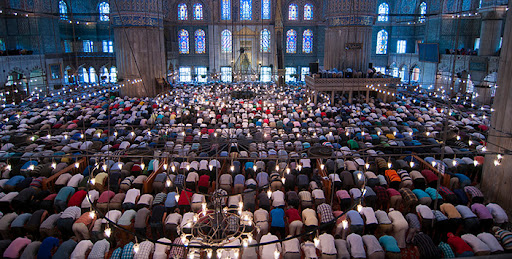
Islam has several ritualistic activities that all Muslims are expected to perform. The most important one is the prayer (Salah), which must be performed according to a specific style. Its importance derives from the fact that it serves as the distinctive trait of a Muslim and because it prevents a Muslim from engaging in sinful activities by putting him into direct contact with Allah five times a day. Thus, the ritual prayer is a chance for him to renew his covenant with Allah and to seek His guidance anew.
The second most important pillar of Islam is Zakat, a term that signifies giving to the less fortunate a certain percentage of one's earnings and holdings. Giving the poor their due and performing the prayer are usually mentioned together in the Quran, for they are both visible manifestations of one's Islamic faith and belief that Allah is the sole owner of everything in the universe, which He allows man to enjoy as His trustee for a specific period of time.
In addition, this act provides a means to redistribute society's wealth in a way that reduces differences between classes and groups. It makes an important contribution to social stability, by purging the soul of the rich person from selfishness and the soul of the poor from envy and resentment against society. This blocks the channels leading to class hatred and makes it possible for the springs of brotherhood and solidarity to gush forth. Such stability is not merely based on the personal feelings of the rich; it stands on a firmly established right that, if denied by the rich, would be exacted by force, if necessary.
The month-long fast of Ramadan (Siyaam) is the third pillar of Islam. Its main function is to make the Muslim pure from "within," just as the external legal code (the Sharee'ah) makes his external actions pure. This process of purification makes it possible for him to respond to what is true and good and to shun what is false and evil.
Fasting, then, awakens an individual's conscience and permits it to share in a communal experience that is engaged in by the entire Muslim world at the same time. Fasting also reminds Muslims of those who are deprived of life's necessities throughout the year or throughout their lives. It makes them realise the suffering of their less fortunate Muslim brothers, a feeling that promotes in them a sense of sympathy and kindness towards Muslims and other people in general.
Lastly, we come to the annual pilgrimage to the House of Allah (the Ka'bah) in Makkah. This ritual, known as the Hajj, is unique to Islam.
Muslims from all corners of the world, all attired in the same clothing, respond in one voice and one language with the following phrase upon entering the sacred precincts: "Labbayk Allahumma Labbayk" (i.e., Here I am n response to your call, O Lord!). This is a time of strict self-discipline and control where not only sacred things are revered, but even the life of plants and birds is made inviolable. Pilgrimage gives an opportunity for all Muslims, regardless of their affiliations with certain groups, classes, organisations, and governments, to meet annually in a great congress. All Muslims are invited to attend, for no individual or government can deny any Muslim the right to do so. Every Muslim who attends is guaranteed full safety and freedom as long as he does not violate its sanctity.
Thus, worship in Islam, whether ritual or non-ritual, trains the individual in such a way that he loves his Creator even more, which causes him to gain an unyielding will and a means to wipe out all evil and oppression from his society and to make the word of Allah triumphant. - islamweb.net