Islam

Islam

Sunday, 31 May 2026

What Does the Quran Teach


What-Does-the-Quran-Teach.jpgThere is a profound question that each and every one of us reflects on at some point during our lives:

"Why am I here, what is my purpose?"

The Quran puts forward a simple but powerful argument with regards to our origins:

"Were they created without any agent? Were they the creators?" (Quran 52:35)

The Quran engages its audience by inviting us to ponder some rational, logical questions which we can use to arrive at a conclusion about our origins.  The first question that the Quran poses to us is: were we created by nothing? Can something really come from nothing?   This is impossible, as we know from our own personal experiences of life as well as the laws of the universe that we couldn’t have come out of nothing, because out of nothing, nothing comes!

This leads us to the next possibility that the Quran proposes: did we create ourselves? Can something create itself?  This is a self-contradiction, because for you to create yourself you would have to already exist, and you can't exist and not exist at same time.  This would be like saying that your mother gave birth to herself!

Since something cannot come from nothing, and self-creation is absurd, this leaves one final possibility: we have a creator.  This is the best explanation not only for our origins but also the universe and everything in it, because it is intuitive and also agrees with reality: whatever begins to exist has a cause or a creator.

This cause or creator must itself be uncaused due to the absurdity of a never-ending chain of causes.  To illustrate this better, if the cause of the universe had a cause and that cause had a cause and so on and so forth forever, then there wouldn’t be a universe to talk about.  For example, imagine if you were told that you couldn’t read this book until you handed it to someone else, and then this other person would also have to give it to someone else, and this went on forever, then would anyone ever read this book? The answer is no.  If we apply this principle to the universe then we would have to conclude that the cause behind it is uncaused out of rational necessity.  The Quran confirms the uncreatedness of the creator:

"He begot no one nor was He begotten." (Quran 112:3)

Now, having a creator is one thing, but how do we know we have a purpose? Everything in this universe has a purpose.  Even simple things like a chair, a bowl and even the book you are holding in your hands serves a purpose.  Wouldn't it be sad if we didn't too have a purpose? If we reflect and look at the world around us, we can easily come to the conclusion that we must have a purpose.  Think about the vastness of our universe with all its billions of galaxies and trillions of planets.  The Qur'an tells us that God did not create all this for no reason:

"We did not create the heavens and the earth and everything between them playfully." (Quran 21:16)

The sun gives us warmth, the clouds give us rain and the trees and animals give us food.  Since a lot of the systems that God has put in place in our universe are to ensure our survival and wellbeing then God must have a purpose in mind for us, too.  This is what the Quran tells us:

"It is God who created the heavens and earth, who has sent down water from the sky and with it brought forth produce to nourish you; He has made ships useful to you, sailing the sea by His command, and the rivers too; He has made the sun and the moon useful to you, steady on their paths; He has made the night and day useful to you and given you some of everything you asked Him for.  If you tried to count God’s favours you could never calculate them" (Quran 14:32–34)

So that nagging question comes up again, what is our purpose?  Again the Qur'an has the answer:

"I created jinn (Quran spirits) and mankind only to worship Me" (Quran 51:56)

Now, what do you understand about 'worship'? Most will say prayer.  This is correct, however in the Qur'an, worship is much more comprehensive than just praying.  It includes all acts of obedience that are pleasing to our Creator.  Even exercise and eating can be an act of worship if our intention is to stay healthy as we can’t stand up and pray if we are ill!

Why perform worship? It's important to understand that our Creator does not need our worship.  In fact the Qur'an tells us this; it is us who are in need of worship.  We as human beings are more than just flesh and bone, we have a spiritual side that also needs nourishing.  Many people are wealthy materially speaking but unhappy with their lives because they neglect their spiritual wellbeing.  In order for us to experience true peace both our bodies and souls need to be in tune with our Creator:

"Truly it is in the remembrance of God that hearts find peace." (Quran 13:28)

So by converting every aspect of our lives into pleasing our Creator, then we will be in a state of constant remembrance of God and our hearts will be at peace.  This is a revolutionary way of thinking but practically, if someone were to do this, a lot of their actions wouldn’t change; however their thought process behind their actions would and they would find the inner peace so needed in today’s society!

So, the question arises - what is the best way to worship God? Let's think about mobile phones.  Mobile phones are obviously not as sophisticated as human beings, but we share many things in common.  We both have a life span, we both require energy to function correctly, and we can both be damaged if we are not taken care of properly.  When mobile phones develop a problem, the first thing most people do is to refer to the instruction manual for the mobile phone.  Why? Because it has been made to show us the best way of using it and we rightly listen to the experts! The creator of the phone knows the best way to use that phone and they have imparted their knowledge to us in the form of instruction manuals.  Similarly then, the Quran is like an instruction manual for humanity as it is from the one who made us.  God, our Creator, knows us better than we know ourselves and this is why His knowledge, His guidance for how we should live will always surpass any human invented philosophies and ways of life. - islamreligion.com

Saturday, 30 May 2026

First Chapter of the Quran


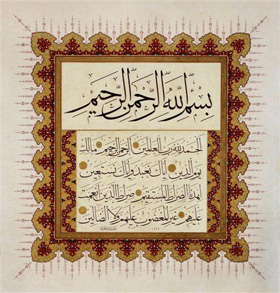
First_Chapter_of_the_Quran_001.jpg“I begin with the name of God, Most Gracious, Most Merciful

All praise is to God, Lord of all the worlds

Most Gracious, Most Merciful

Master of the Day of Judgment

You Alone do we worship and You Alone do we ask for help

Guide us to the straight path

The Path of those on whom You bestowed Your bounties

Not the path of those who incurred Your wrath or those who went astray.” (Quran 1:1-7)

Prophet Muhammad, may the mercy and blessings of God be upon him, told us, that this chapter in the Quran is unlike any other. Nothing like it was revealed in any previous scripture. When one recites this chapter sincerely they would be professing their belief as a true Muslim.

All praise is to God

When you state that all praise is due to God alone, you are in fact acknowledging that only He has all the attributes of perfection and that only He is the bestower of all the bounties that any of His creation enjoys.  And since gratefulness is the essence of worship, you are also acknowledging that He is the only one who deserves to be worshipped.

Lord of all the worlds

The Arabic word for Lord, Rubb, conveys a number of meanings that are not accurately captured by the English word Lord. It means that He is the one who owns, who creates, who sustains and who looks after all that exists.  The only relationship between Him and all creation is that He is the creator of all that exists.  He cannot therefore be the father of anyone in any real sense! To say that He is the Creator and yet the father of some of His creation is a contradiction in terms.  You don’t create your child, you beget him.  It is because of this that the Quran keeps reminding those who claim that God has children (the Arabs who used to say that the angels are the daughters of God, the Christians who say that Jesus is the son of God, and a Jewish sect who used to believe that Ezra is the son of God) that God is the Creator and Owner of everything.    

Most Gracious, Most Merciful

The two Arabic words, Rahman and Raheem, for which these English phrases stand, are two intensive forms of a root word which conveys the meaning of mercy.  Rahman is more intensive than Raheem, and refers to God’s all-encompassing mercy, His mercy to all His creation in this life and the life to come.  Raheem refers to His special mercy to the faithful.  No created being can therefore be Rahman, but created beings can be described as Raheem in a limited and special sense of the word. 

Master of the Day of Judgment

God is the Master of all days and all things, but while some people can have some limited mastership or even falsely claim to have it, no one can be, or claim to be master in any sense on the Day of Reckoning.  On that Day God will ask all of His creation: “To whom is sovereignty today?” And the answer will be “To God, the One who holds absolute sway over all that exists”.  This reminds us of the fact that this world is only a transient station on the road to the final abode where we shall either be rewarded or punished for what we do here. 

You Alone do we worship and You Alone do we ask for help

The foregoing verses were like an introduction to this one.  It is as if you are saying: because we acknowledge the fact that all praise is to You, that You are the Lord of all the worlds, that You are Most Gracious and Most Merciful, and that You Alone are the Master of the Day of Judgment, we hereby declare that we worship none but You and seek help from none except You.   This verse emphasizes the fact that what is important is not only that You worship God, but that you worship none besides Him, because none except Him deserves to be worshipped.  Worship in the broader sense of the word includes that you obey none but Him in any absolute sense, love no one as or more than you love Him and pray to no one except Him. It also includes that you seek help from none but God; this doesn’t mean that you don’t extend or accept any help from any of God’s created beings in matters in which they have the power to help.  It only means that you believe that even when you give or receive such help that it is ultimately coming from God because nothing in this world happens without His will and power.  So it is from Him alone that you are ultimately turning for help, and it is on Him that you ultimately and absolutely depend. 

Guide us to the Straight path

Having acknowledged all those truths about God, and having declared to Him that it is He Alone that we worship and ask for help, we now go on to ask Him to grant us the thing that we need most: knowing and taking the shortest path that leads to Him.  Having known who God is we are convinced that such guidance must come from Him, that it must be available to all who want to follow it, and that there must be no doubt about the fact that it is from Him.  That guidance, we know, is no where to be found in any complete way except in God’s words, the words that He revealed to His chosen Prophets like Noah, Abraham, Moses, Jesus and Muhammad, may God praise them all.  But we also know for sure that none of the books that contain that guidance is now at our disposal except one - the Quran.  It is to this Divine book that we must turn for a detailed description of the Straight Path that leads to our Lord.  This path is an absolute path that was given to each Prophet and Messenger of God and it does not change over the passage of time.

The Path of those on whom You bestowed Your bounties

The straight path described in the Quran is not a theoretical path; it is an actual path that some people before us have taken.  As Muslims, we believe every Prophet and Messenger of God preached the belief in the Oneness of God and that all worship was to be dedicated to Him alone.

Not the path of those who incurred Your wrath or those who went astray

Just as the Straight Path is described above in a positive way, the paths of those who deviated from it are described in a negative manner. We always ask our Lord to keep us away from the paths taken by two kinds of deviant people: those who knew the truth about religion and yet refused to act according to it, and there brought upon themselves the wrath of God. The second group of people were those who made their religion suit their whims and desires and are thus went astray.  The Quran tells us in some detail about their main deviations, among the greatest of which is that they have no great respect for God or His words: they ascribe to Him imperfect, even insulting attributes; they distort His words at will to make them suit their own wishes or preferences and they commit immoralities in the name of religion. - islamreligion.com

Friday, 29 May 2026

What Is the Meaning of “Yaum Al-Hajj Al-Akbar” in Quran?


Initially Al-Hajj Al-Akbar means the major pilgrimage, which is Hajj performed in the month of Zul-Hijjah; while the minor pilgrimage is Umrah that is performed at any other time of the year:

Ibn Masood (may Allah be pleased with him) said:

“You have been ordered to establish four things – establish prayers, give alms, establish Hajj and Umrah to the House; and Hajj is the major pilgrimage while Umrah is the minor pilgrimage” (Al-Haithami in Mojmaa Al-Zawaid – Hasan)

There are many other authentic hadith relating the same information; therefore, every Hajj is Al-Hajj Al-Akbar, unlike the common misconception that when Arafah coincide on a Friday then it is called Al-Hajj Al-Akbar.

The translation of the verse you quoted is:

{And a declaration from Allah and His Messenger to mankind on the greatest day (the 10th of Dhul-Hijjah – the 12th month of Islamic calendar)…} (At-Taubah, 9:3)

Maududi explained the above statement as follows:

Yaum Al-Hajj Al-Akbar refers to the 10th of Zul-Hijjah and is also known as Yaum-un-Nahr (day of sacrifice). This has been explained by the Holy Prophet in an authentic Tradition. On the 10th of Zul-Hijjah, during the last Haj of the Holy Prophet, he asked the people, “What is this day?” The people answered, “It is the day of Sacrifice.”

The Holy Prophet said, “This is the day of Al-Hajj Al-Akbar” (Al-Bukhari).

Here the word Al-Hajj Al-Akbar (Great Pilgrimage) has been used in contrast to Al-Hajj Al-Asghar which the Arabs used for ‘Umrah’. Thus, the Hajj which is performed in the prescribed dates of Zul-Hijjah is called Al-Hajj Al-Akbar.”

Ibn Al-Qayyim also mentioned in his book Zad Al-Miaad:

“The day of the major pilgrimage is the day of sacrifice”

As for Arafah falling on a Friday, there is nothing in authentic Islamic sources that suggests that the Hajj is more rewarding. However, scholars have concluded that because two blessed days have coincided then there is more blessings due to the following facts:

Arafah is the best day of the year and Friday is the best day of the week based on the following hadith; Abu Hurairah reported that the Prophet (peace be upon him) said:

“The best day on which the sun rises is Friday. On it Adam was created, on it he was admitted to Paradise, on it he was expelled therefrom, and on it the Hour will begin. On that day there is an hour when no Muslim slave asks Allah for something good but He will grant it to him.” (Sahih Muslim)

The prophet’s only hajj also happened to have fallen on a Friday. On that day, he (peace be upon him) received one of the most important verses in the Quran; Narrated Umar Ibn Al-Khattab:

Once a Jew said to me, “O chief of believers! There is a verse in your Holy Book which is read by all of you (Muslims), and had it been revealed to us, we would have taken that day (on which it was revealed as a day of celebration.”

Umar bin Al-Khattab asked, “Which is that verse?” The Jew replied, {This day I have perfected your religion For you, completed My favor upon you, And have chosen for you Islam as your religion.} (Al-Maeda, 5:3) Umar replied, “No doubt, we know when and where this verse was revealed to the Prophet. It was Friday and the Prophet (peace be upon him) was standing at Arafah (i.e. the Day of Hajj)” (Sahih Al-Bulhari)

- aboutislam.net

About Maen Khalifa
Maen has many years of experience in dawah work. He formerly worked as the Ask About Islam Editor and a consultant.

Thursday, 28 May 2026

Why Don’t Women Have Standard Hajj Clothes?

 A questioner asks why don’t women have standard Hajj clothes like the men do? Find out with Dr. Shabir Ally.

- aboutislam.net

Wednesday, 27 May 2026

Al-Adha and the Meaning of Sacrifice


Korban in Malaysia

The Meaning of ‘Udhiya’

In Shariah, or Divinely Revealed Law, udhiya means the ritual sacrifice performed on specific days and fulfilling explicit conditions with the intention of coming closer to God. Hence, anything slaughtered on other days for the sake of Allah is not an udhiya. Also, whatever we slaughter on these designated days of sacrifice that is not directly for His sake in fulfillment of the ritual of that day, such as a butcher slaughtering for sale, is not an udhiya.

The Purpose of Al-Udhiya

While it is not possible to fully fathom the divine knowledge that underlies the udhiya, one can discern some of its purposes:

  1. The udhiya manifests, from the deep of one’s soul, one’s gratitude to Allah for bringing one into existence.

  2. The udhiya is a revival of the primordial way of Ibrahim, on him be peace, father of Prophets. The believer slaughters his sacrifice in remembrance of the epic patience that Ibrahim and Ismail, on him be peace, called up from the depths of their extraordinary iman (faith) in obedience to the arduous commandment and test of their faith from Allah.

  3. The udhiya is an act of open refutation against those who say it is unlawful for human beings to slaughter animals and eat meat due to the pain it causes animals or on account of human claims that God has designated certain categories of animals sacred as part of religious worship.

  4. The udhiya establishes that the most humane method of killing an animal is the stroke of slaughter that releases its blood flow.

  5. The udhiya is an overt demonstration that Allah subjugated the earth to humankind and made it moral for us to take the life of these designated creatures to fulfill our need as human beings. As such, it increases our gratitude to Allah for His immense favor upon us and for His raising of us above much of His creation.

Conditions of Obligation and of Sunnah Mu’akkadah

  1. The slaughterer is Muslim. The udhiya is not stipulated for a non-Muslim because the intention of its action is to cause those sacrificing to draw nearer to Allah in worship, and one must freely submit one’s will to Allah’s before one may act to draw closer to Him.

  2. The slaughterer is a resident not traveler. The traveler is not obligated to perform the udhiya because it must be a sacrifice of an animal, and the escort of an animal of sacrifice on one’s journey burdens one.

  3. The slaughterer is in a state of financial ease. The proof of this is the statement of the Prophet, on him be peace, conditioning the udhiya for “one who has ample wealth.”

  4. The slaughterer is an adult of sound mind. This is a condition according to those who categorize the udhiya as Sunnah. Among those who deem it an individual obligation, some hold that the udhiya must be performed on behalf of the insane and minor if they meet the bar of wealth.

Conditions for the Validity of Al-Udhiya

  1. The sacrifice must be of animals normally considered livestock, namely: cattle, such as cows, buffaloes, bison (bovine); sheep (ovine), goats (caprine), camels, and the like. Thus slaughtering of fowl, for example — even many chickens, turkeys, or ducks — does not count for udhiya.

  2. It matters not whether the sacrifice is male or female.

  3. The companions were never reported to have slaughtered anything other than the above-mentioned animals for Eid al-Adha.

  4. A sheep or goat counts for one person. Up to seven may share in a camel or cow. The companion Jabir said: “We performed Hajj along with Allah’s Messenger, and we sacrificed a camel on behalf of seven, and a cow on behalf of seven” (Muslim, 7, #3024).

  5. The sacrifice must be full grown, about six months for a goat, one year for a sheep, three years for a cow, and five years for a camel.

  6. The sacrifice should be free of defect, especially as to its meat quality.

The Time of Al-Udhiya

The time of al-udhiya begins at Fajr (dawn) of Eid Al-Adha, the second Eid. However, it must be performed after the Eid Salah or Prayer, not before, as is the custom in some Muslim countries. While it is permissible to sacrifice before the khutbah (sermon) that follows the Eid Salah, it is preferable to sacrifice after it.

If one lives in an area that convenes a number of Eid Prayers, it is sufficient for one of these congregations to complete its prayer for one to perform one’s sacrifice thereafter. If one lives in a place where the prayer is normally held but is delayed to the second day of Eid for any reason, or is not held at all, then the time of slaughter begins when the due time for Eid Salah on the first day ends, that is, after the sun crosses its zenith. If, however, one lives in a place where there is no Eid Salah, then one can slaughter any time after sunrise.

The time of sacrifice ends, according to the Hanafi, Maliki, and Hanbali schools of Law, with sunset of the third day of Eid. The Shafi‘i position, however, is that the Days of Slaughter are four, including Eid Day. Their proof is the reliable statement of the Prophet, on him be peace: “All the days of tashriq (of laying out meat for jerking) are days of sacrifice.”

Any sacrifice outside these times is not an udhiya.

Distribution of Meat

The Sunnah of al-udhiya is fulfilled by letting the blood of the sacrifice flow, that is to say, by performing the sacrifice. It is preferable, however, that one distribute a third of the meat to the poor in charity, give a third away as gifts to neighbors, relatives, and friends, and keep a third of the meat for one’s household. These meat portions should be of equal proportion, one-third each.

If one’s own household is in need of meat, the slaughterer should keep most of it for the household. If one has a needy relative and is not in need, one should give most of it to him or her. If the one sacrificing and his or her relatives are wealthy, then one should give most of the meat away in charity. - zakat.org

Tuesday, 26 May 2026

What is Eid-ul-Adha?


There are two key Eid’s (Celebration Festivals) in Islam: Eid-ul-Fitr, which signifies the completion of the Holy Month of Ramadan; and Eid-ul-Adha, the greater Eid, which follows the completion of the annual Hajj pilgrimage, at the time of Qurbani (sacrifice).

Although Eid-ul-Adha has no direct relation to the Hajj Pilgrimage, it is but a day after the completion of Hajj and therefore has significance in time.


The day of Eid-ul-Adha falls on the tenth day in the final (twelfth) month of the Islamic Lunar Calendar; Dhu-al-Hijjah. The day that celebrations fall on is dependent on a legitimate sighting of the moon, following the completion of the annual Holy Pilgrimage of Hajj -  which is an obligation for all Muslim’s who fit specific criteria, one of the important Five Pillars of Islam.

The celebration of Eid-ul-Adha is to commemorate Prophet Ibrahim’s devotion to Allah SWT and his readiness to sacrifice his son, Ismail. At the very point of sacrifice, Allah SWT replaced Ismail with a ram, which was to be slaughtered in place of his son. This command from Allah SWT was a test of Prophet Ibrahim’s willingness and commitment to obey his Lord’s command, without question. Therefore, Eid-ul-Adha means the festival of sacrifice.

Depending on the country, the celebrations of Eid-ul-Adha can last anywhere between two and four days. The act of Qurbani (sacrifice) is carried out following the Eid Salaah (Eid Prayers), which are performed in congregation at the nearest Mosque on the morning of Eid.

The act of Qurbani consists of slaughtering an animal as a sacrifice to mark this occasion in remembrance of Prophet Ibrahim’s sacrifice for Allah SWT. This is also known as Udhiya. The days of animal sacrifice total three days, from the 10th to the 12th of Dhu-al-Hijjah.

The sacrificial animal must be a sheep, lamb, goat, cow, bull or a camel; the sheep, lamb or goat consist of one Qurbani share, whereas a bull, cow or camel consist of seven shares per animal. The animal must be in good health and over a certain age in order to be slaughtered, in a “halal” friendly, Islamic way.

The Qurbani meat can then divided into three equal portions per share; one-third is for you and your family, one-third is for friends, and the final third is to be donated to those in need.

Traditionally, the day is spent celebrating with family, friends and loved ones, often wearing new or best attire and the giving of gifts.  muslimaid.org

Eid Al-Adha or Selamat Hari Raya Haji or Selamat Hari Korban will be celebrated in Malaysia tomorrow, 27 May 2026.

Monday, 25 May 2026

Kind Treatment of Wives


Kind Treatment of Wives

Kind_Treatment_of_Wives_001.jpgGod instructs men to be nice to their wives and to treat them well to the best of their ability:

"…And live with them in kindness…" (Quran 4:19)

The Messenger of God said, The most perfect of believers in belief is the best of them in character.  The best of you are those who are the best to their women.’[1]  The Prophet of Mercy tells us that a husband’s treatment of his wife reflects a Muslim’s good character, which in turn is a reflection of the man’s faith.  How can a Muslim husband be good to his wife?  He should smile, not hurt her emotionally, remove anything that will harm her, treat her gently, and be patient with her.

Being nice includes good communication.  A husband should be willing to open up, and be willing to listen to his wife.  Many times a husband wants to air his frustrations (like work).  He should not forget to ask her about what annoys her (like when children would not do their homework).  A husband should not talk about important things with her when he or his wife is angry, tired, or hungry.  Communication, compromise, and consideration are the cornerstone of marriage.

Being nice includes encouraging one’s wife.  The most meaningful admiration comes from a sincere heart that notices what really matters — what the wife really values.  So a husband should ask himself what she feels most insecure about and discover what she values.  That is the wife’s sweet spot of praise.  The more the husband compliments it, the more the wife will admire it, the more on target this healthy habit will be.  Kind words are like, "I like the way you think," "You look beautiful in those clothes," and "I love hearing your voice on the phone."

Human beings are imperfect.  The Messenger of God said, "A believing man should not hate a believing woman.  If he dislikes something in her character, he should be pleased with some other trait of hers."[2]  A man should not hate his wife because if he dislikes something in her, he will find something he likes about her if he gives it a chance.  One way to be aware of what he likes in his wife is for the husband to make a list of a half dozen things he appreciates about her.  Marriage experts recommend that one be as specific as possible and focus on character traits — just as the Prophet of Islam recommended, not just what she does for the husband.  For example, a husband may appreciate the way she arranges his clean laundry, but the underlying character trait may be that she is thoughtful.  The husband should consider admirable traits such as being compassionate, generous, kind, devout, creative, elegant, honest, affectionate, energetic, gentle, optimistic, committed, faithful, confident, cheerful, and so on.  A husband should give himself some time to construct this list, and review it in times of conflict when he is most likely to feel averse towards his wife.  It will help him be more aware of his wife’s good attributes and far more likely to compliment them.

A companion asked the Prophet of God what is the right of a wife over her husband?’  He said, "That you feed her when you eat and clothe her when you clothe yourself and do not strike her face.  Do not malign her and do not keep apart from her, except in the house."[3]

Conflict in marriage is virtually inevitable and it leads to lot of anger.  Although anger is one of the most difficult emotions to manage, the first step toward controlling it can be learning how to forgive those who hurt us.  In case of conflict, a husband should not stop talking to his wife and emotionally hurt her, but he may stop sleeping in the same bed if it will improve the situation.  Under no circumstance, even when he is angry or somehow feels justified, is a husband allowed to malign her by using hurtful words or cause her any injury.

- islamreligion.com

Footnotes:

[1]Al-Tirmidhi

[2]Saheeh Muslim.

[3]Abu Daud.

Saturday, 23 May 2026

The Miraculous Quran : My Path to Islam


Opening Statement

The_Miraculous_Quran_(part_1_of_11)_001.jpgLet me state at the outset that, after being Muslim for many years now, if I were given the topic of “The Miraculous Quran,” as I see it now, I would be emphasizing and discussing aspects that were completely unknown to me at the time that I was studying Islam as a non-Muslim.  I have been studying the Quran for over thirty years now and it never fails to fascinate me.  In fact, the phenomenon of continually finding new fascinating aspects of the Quran has been true for the Muslim scholars throughout the years.  Over the centuries, as they have spoken about the Quran, later scholars recognize the miraculous aspects that the earlier scholars mentioned while coming across other aspects that they consider no less remarkable and amazing.  Thus, for example, in the past century, we have had Aishah bint al-Shaati, Sayyid Qutb and Mustafa Saadiq al-Raafi’ee all adding components to the overall theory of the miraculous nature of the Quran.[1]  Lately, many have emphasized what are called the “scientific miracles of the Quran,” a topic we shall try to visit toward the end of this lecture.

However, this lecture is about “my story” and my path to Islam via the Quran.  Therefore, I will be emphasizing those aspects of the Quran that influenced me the most at that time and I will give less time to other aspects that I have studied in detail since then.

A Very Brief Introduction to the Prophet Muhammad and the Quran

I am sure that most of you have some familiarity with the Prophet Muhammad, may the mercy and blessings of God be upon him, and the Quran but for some points that I will make later, I believe a very brief introduction to the two is in order.

Muhammad was born around 570 years after the birth of Jesus Christ.  He was born in Mecca, in the Arabian Peninsula.  The people of Mecca were devoted to idol-worship.  The area was not known as a place of advanced civilization or learning at its time.  In fact, the Prophet Muhammad was illiterate.  At the age of forty, Muhammad received his first revelation.  Although he was known among his people as “the trustworthy,” the majority of the Arabs belied him and soon after started a massive campaign to persecute those who believed in him.  After thirteen years of preaching in Mecca, the Prophet himself left for the city of Medina, where he already had some followers.  They made him the leader of the city.  The disbelievers of Mecca did not rest and attempted to militarily squash the new faith.  However, what was originally a small band of Muslims grew in number and were able to withstand the onslaught of the disbelievers.  Within ten years, the Prophet himself led an army back to Mecca and conquered it in a bloodless victory.  Thus, Islam became victorious in Arabia and began spreading throughout the world.  The Prophet Muhammad finally died in 632.

As for the Quran, it was revealed to the Prophet Muhammad over a period of twenty-three years.  It was revealed directly to him via the angel Gabriel.  He would receive the revelation and then convey it to his followers.  Thus, the Quran is very different from the Bible.  There are no human contributions to the Quran; it is only the revelation from God.  In other words, you will not find any stories about the Prophet written by his Companions in the Quran.  In fact, you will not even find in the Quran any of the Prophet’s speech outside of what he stated to be the revelation of the Quran.  The Prophet’s own words have been kept completely separate from the Quran.

One final note, the Quran is only in Arabic.  The best translation is not the Quran.  Once you lose something in its original wording and rely only on translation, the original is truly lost.

The Story of My Conversion and my Near Baptism

The story of my conversion is not the most fascinating.  However, one aspect is of interest: the affect that the Quran had on me.

My family moved to California from Spain.  Thus, we were nominally Catholic.  I had very little exposure to any religion until a friend of mine in school invited me to their church.  I started attending and this was the first time that I began to read the Bible.  I was definitely taking everything very seriously.  There then came the time to be baptized.  I had no problem with it except that I decided that, since this was the first religion I was exposed to, I should just look around at other religions to make sure that I was certain about what I was doing.  I did not think this would actually affect my final decision while, in reality, that near baptism led me to becoming a Muslim.

I started studying about all religions I could find.  This, obviously, is what led me to the Quran.

- islamreligion.com

Footnotes:

[1]For a discussion of these recent additions to the concept of the miraculous nature of the Quran, see Muhammad Rafii Yunus, “Modern Approaches to the Study of I’jaz al-Quran (Ph.D. Dissertation, University of Michigan, 1994), pp. 78-91 and 118-125.