Islam

Islam

Tuesday, 22 November 2022

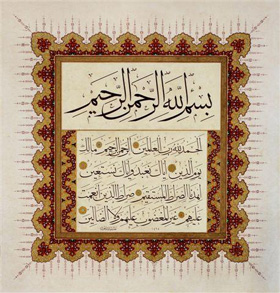
FIRST CHAPTER OF THE QURAN


“I begin with the name of God, Most Gracious, Most Merciful

All praise is to God, Lord of all the worlds

Most Gracious, Most Merciful

Master of the Day of Judgment

You Alone do we worship and You Alone do we ask for help

Guide us to the straight path

The Path of those on whom You bestowed Your bounties

Not the path of those who incurred Your wrath or those who went astray.” (Quran 1:1-7)

Prophet Muhammad, may the mercy and blessings of God be upon him, told us, that this chapter in the Quran is unlike any other. Nothing like it was revealed in any previous scripture. When one recites this chapter sincerely they would be professing their belief as a true Muslim.

All praise is to God

When you state that all praise is due to God alone, you are in fact acknowledging that only He has all the attributes of perfection and that only He is the bestower of all the bounties that any of His creation enjoys.  And since gratefulness is the essence of worship, you are also acknowledging that He is the only one who deserves to be worshipped.

Lord of all the worlds

The Arabic word for Lord, Rubb, conveys a number of meanings that are not accurately captured by the English word Lord. It means that He is the one who owns, who creates, who sustains and who looks after all that exists.  The only relationship between Him and all creation is that He is the creator of all that exists.  He cannot therefore be the father of anyone in any real sense! To say that He is the Creator and yet the father of some of His creation is a contradiction in terms.  You don’t create your child, you beget him.  It is because of this that the Quran keeps reminding those who claim that God has children (the Arabs who used to say that the angels are the daughters of God, the Christians who say that Jesus is the son of God, and a Jewish sect who used to believe that Ezra is the son of God) that God is the Creator and Owner of everything.    

Most Gracious, Most Merciful

The two Arabic words, Rahman and Raheem, for which these English phrases stand, are two intensive forms of a root word which conveys the meaning of mercy.  Rahman is more intensive than Raheem, and refers to God’s all-encompassing mercy, His mercy to all His creation in this life and the life to come.  Raheem refers to His special mercy to the faithful.  No created being can therefore be Rahman, but created beings can be described as Raheem in a limited and special sense of the word. 

Master of the Day of Judgment

God is the Master of all days and all things, but while some people can have some limited mastership or even falsely claim to have it, no one can be, or claim to be master in any sense on the Day of Reckoning.  On that Day God will ask all of His creation: “To whom is sovereignty today?” And the answer will be “To God, the One who holds absolute sway over all that exists”.  This reminds us of the fact that this world is only a transient station on the road to the final abode where we shall either be rewarded or punished for what we do here. 

You Alone do we worship and You Alone do we ask for help

The foregoing verses were like an introduction to this one.  It is as if you are saying: because we acknowledge the fact that all praise is to You, that You are the Lord of all the worlds, that You are Most Gracious and Most Merciful, and that You Alone are the Master of the Day of Judgment, we hereby declare that we worship none but You and seek help from none except You.   This verse emphasizes the fact that what is important is not only that You worship God, but that you worship none besides Him, because none except Him deserves to be worshipped.  Worship in the broader sense of the word includes that you obey none but Him in any absolute sense, love no one as or more than you love Him and pray to no one except Him. It also includes that you seek help from none but God; this doesn’t mean that you don’t extend or accept any help from any of God’s created beings in matters in which they have the power to help.  It only means that you believe that even when you give or receive such help that it is ultimately coming from God because nothing in this world happens without His will and power.  So it is from Him alone that you are ultimately turning for help, and it is on Him that you ultimately and absolutely depend. 

Guide us to the Straight path

Having acknowledged all those truths about God, and having declared to Him that it is He Alone that we worship and ask for help, we now go on to ask Him to grant us the thing that we need most: knowing and taking the shortest path that leads to Him.  Having known who God is we are convinced that such guidance must come from Him, that it must be available to all who want to follow it, and that there must be no doubt about the fact that it is from Him.  That guidance, we know, is no where to be found in any complete way except in God’s words, the words that He revealed to His chosen Prophets like Noah, Abraham, Moses, Jesus and Muhammad, may God praise them all.  But we also know for sure that none of the books that contain that guidance is now at our disposal except one - the Quran.  It is to this Divine book that we must turn for a detailed description of the Straight Path that leads to our Lord.  This path is an absolute path that was given to each Prophet and Messenger of God and it does not change over the passage of time.

The Path of those on whom You bestowed Your bounties

The straight path described in the Quran is not a theoretical path; it is an actual path that some people before us have taken.  As Muslims, we believe every Prophet and Messenger of God preached the belief in the Oneness of God and that all worship was to be dedicated to Him alone.

Not the path of those who incurred Your wrath or those who went astray

Just as the Straight Path is described above in a positive way, the paths of those who deviated from it are described in a negative manner. We always ask our Lord to keep us away from the paths taken by two kinds of deviant people: those who knew the truth about religion and yet refused to act according to it, and there brought upon themselves the wrath of God. The second group of people were those who made their religion suit their whims and desires and are thus went astray.  The Quran tells us in some detail about their main deviations, among the greatest of which is that they have no great respect for God or His words: they ascribe to Him imperfect, even insulting attributes; they distort His words at will to make them suit their own wishes or preferences and they commit immoralities in the name of religion. -islamreligion.com


Monday, 21 November 2022

The message of the messengers


Allah, the All Wise, All Knowing, All Merciful and Just, created this Universe in order to test and examine His obedient slaves and reward them, and to punish the disobedient. He Says (what means): "We did not create the heavens and the earth and that between them in play. We did not create them except in truth, but most of them do not know." [Quran 44: 38-39]
Allah also made clear the main goal for the creation of mankind, Saying (what means): "I did not create the Jinn and Mankind except for My worship" [Quran 51: 56]
Allah, the Exalted, did not leave His slaves to rely upon their intellect and inclination to guide them to the correct way; rather He sent them Messengers as bringers of good tidings and warners. He sent the revealed Books with them to be a reference in those matters wherein they disagreed, so that no excuse would remain for the people and the proof would be established against them. Thus, after sending the Messengers, there would be no further excuse for people before Allah.
Indeed, their mission covered every good and banished every evil. They brought to humankind everything needed for their well being and happiness in this world and the Hereafter. There is nothing good, which they did not inform the people about and nothing evil that they did not warn the people against.
‘Abdullaah bin `Amr bin Al-`Aas, may Allah be pleased with him, said that the Prophet  sallallaahu  `alayhi  wa  sallam ( may  Allah exalt his mention ) said: "There was never a Prophet before me except that it was a duty upon him that he should guide his nation to every good that he knew and warn them against every evil that he knew…" [Muslim]
Indeed, calling to Allah was the mission of the Messengers in order to bring the people out from darkness into light. There are many basic principles upon which their calls were based, which were the starting point for calling to Allah. These fundamental principles are:
1. Tawheed (Monotheism)
2. Prophethood
3. The Hereafter
Every book revealed by Allah gave great importance to these points. The most important and sublime of these three principles and the most fundamental of them all is Tawheed (Oneness) of Allah.
Allah Says (which means): "And We certainly sent into every nation a Messenger, (saying): 'Worship Allah and avoid Taaghoot (false objects of worship).' " [Quran 16: 36]
Allah has informed us about some of the Prophets, may Allah exalt their mention, and how they faced their people. We see that all of them proceeded upon the universal way laid down by Allah and followed the methodology Allah established for all of them. Not a single one of them is at variance with it, Allah Says (which means): "And We had certainly sent Nooh to his people, (saying): 'Indeed, I am to you a clear warner, that you not worship except Allah. Indeed, I fear for you the punishment of a painful Day.'" [Quran 11: 25-26]
The noblest of all Prophets and the last of them, Muhammad bin ‘Abdullaah  sallallaahu  `alayhi  wa  sallam ( may  Allah exalt his mention ) (who was sent with the greatest, most complete and comprehensive message), began with what all the Prophets, may Allah exalt their mention, started their Da’wah (call) -- calling to the 'Aqeedah (creed) of Tawheed (Oneness of Allah), and calling for all worship to be made purely and sincerely for Allah alone. Allah's Messenger  sallallaahu  `alayhi  wa  sallam ( may  Allah exalt his mention ) started with the principle: 'Witness that none has the right to be worshipped except Allah.'
Allah Says (what means): "Say, (O Muhammad): 'O mankind, indeed I am the Messenger of Allah to you all, (from him) to Whom belongs the dominion of the heavens and the earth. There is no deity except Him; He gives life and causes death.' So believe in Allah and His Messenger, the unlettered Prophet, who believes in Allah and His words, and follow him that you may be guided." [Quran 7: 158]
The verses in this regard are many, what we quote here is just one example. With regard to the Sunnah (traditions and approved actions of Prophet Muhammad  sallallaahu  `alayhi  wa  sallam ( may  Allah exalt his mention )), there are many clear indications that Allah's Messenger began his call to Islam with Tawheed.
1.     `Amr bin Abasah As-Sulami, may Allah be pleased with him, said: "During the times of ignorance … I heard of a man in Makkah who received revelation. So I set upon my riding beast and came to him. At that time he was in hiding, due to the oppression of his people. So I behaved in a way that enabled me to gain access to him in Makkah. I said to him: "Who are you?" He replied: "I am a Prophet.' So I said: "And what is a Prophet?' He said: 'Allah has sent me as a Messenger.' So I said: 'And what is it that He has sent you with?' He said: 'I have been sent to order the joining of ties of relationship, to break the idols, so that Allah is worshipped Alone and nothing at all is associated in worship along with Him."  [Muslim]
2.     At the time of the peace of Hudaibiyyah, Hiraql (Heraclius) asked Abu Sufyaan some questions about Allah's Messenger, among which he asked: "What does he (Muhammad) command you?" Abu Sufyaan replied: "He says, 'Worship Allah Alone and do not worship anything else along with Him, and abandon what your fathers say. He also orders prayers, charity, and the joining of the ties of relationship.'" [Al-Bukhari]
 Consequently, the Prophets, may Allah exalt their mention, did not come to bring about the downfall of one State to replace it with another. They did not seek sovereignty, nor did they organize political parties for this reason. Rather, they came for the guidance of humankind, to save it from misguidance and Shirk (polytheism), and to take them out of darkness into light.
In this regard Prophet Muhammad  sallallaahu  `alayhi  wa  sallam ( may  Allah exalt his mention ) gave an example about himself. He  sallallaahu  `alayhi  wa  sallam ( may  Allah exalt his mention )  said: "The similitude of me and the message with which Allah has sent me, is like a man who came to some people and said: ‘I have seen the enemy forces with my own eyes and I am a mere warner (to you). So, save yourselves, save yourselves!’ A group of his people obeyed him and went out at night, slowly and steadily and was safe; while another group belied him and stayed in their place until the morning when the army destroyed them. Such is the similitude of those who obey me and follow what I have brought (i.e., Message) and of those who disobey me and belie the Truth which I have brought." [Al-Bukhari, Muslim and others]
The Message of the Messengers, by the Mercy of Allah, revives and enlightens the believer’s soul. This enlightenment is the revelation of Allah, which leads mankind from the darkness of Shirk (polytheism) and ignorance to the Light of Truth and Islam: "Allah is the ally  of those who believe. He brings them out from darkness into the light." [Quran 2: 257]
The Messenger and the Message are evidence against the disbelievers
Allah sent His Messengers and His Books so that there can be no excuse for mankind on the Day of Judgment. The Quran says (what means): "(we sent) Messengers as bringers of good tidings and warners so that mankind will have no argument against Allah after Messengers." [Quran 4: 165]
The Message of Allah deals with the rights of Allah on His bondsmen, the rights of man on His Creator, The Oneness of Allah and its influence on the creation, knowledge, admonition, the wisdom behind the creation, righteousness, mutual interactions, refutation of incorrect beliefs and deviations, lawful and unlawful, migration and Jihaad. In totality, it is the complete code for righteous living, which results in delight, pleasure and harmony in this life and the Hereafter. - islamweb.net

Sunday, 20 November 2022

Let Go and Trust God (Story of Musa’s Mother)


Ustadha Lobna Mulla narrates the story of the mother of Prophet Musa (pbuh) and her courage in trusting Allah (SWT), putting all her hope in Him to protect her baby. She advises us on the importance to let go and have tawakkul. Subhana Allah!

- aboutislam.net

Saturday, 19 November 2022

The myth of 'self organization of matter'


Quite aware that the Second Law of Thermodynamics renders evolution impossible, some evolutionist scientists have made speculative attempts to close the gap between the two, so as to render evolution possible. As usual, even those endeavors show that the theory of evolution faces an inescapable impasse.

One person distinguished by his efforts to marry thermodynamics and evolution is the Belgian scientist Ilya Prigogine. Starting out from the 'Chaos Theory', Prigogine proposed a number of hypotheses in which ordered forms come into existence from chaos (disorder). He argued that some open systems can portray a decrease in entropy due to an influx of outer energy and the resultant outcome “ordering”, is a proof that “matter can organize itself.” Since then, the concept of the “self-organization of matter” has been quite popular among evolutionists and materialists. They act like they have found a materialistic origin for the complexity of life and a materialistic solution for the problem of life’s origin.

But a closer look reveals that this argument is totally abstract and in fact just wishful thinking. Moreover, it includes a very naïve deception. The deception is the deliberate confusion of two distinct concepts, “self organization” and “self ordering.”

We can explain it by an example. Imagine a sea shore with different types of stones mixed with each other -- big stones, smaller stones and very tiny ones. When a strong wave hits the shore, there may appear an “ordering” among the stones. The water will raise the ones with equal weights in equal amounts. When the wave goes back, the stones may possibly be ordered from the smallest to the biggest towards the sea.

This is a “self ordering” process: the seashore is an open system and an influx of energy (the wave) may cause an “ordering”. But note that the same process can not make a castle of sand in the seashore. If we see a castle made of sand, we are sure that someone has made it. The difference between the castle and the “ordered” stones is that the former includes a very unique complexity, while the latter includes only repetitive order. It is like a typewriter typing “aaaaaaaaaaaaaaa” for hundreds of times – because an object (an influx of energy) fell onto the letter “a” on the keyboard. Of course, such a repetitive order of “a” s does not include any information and thus any complexity. You need a conscious mind to have a complex sequence of letters that includes information.

The same thing applies when wind enters a room full of dust. Before this influx, the dust may be scattered around. When the wind comes in, the dust may be collected in a corner of the room. This is “self ordering”. But the dust never “self organizes” itself and creates a picture of a man on the floor of the room.

These examples are quite similar to the ‘self organization' scenarios of evolutionists. They argue that matter has a tendency for self organization, then give examples of self ordering and then try to confuse both concepts. Prigogine himself gave examples of self ordering molecules during influx of energy. The American scientists Thaxton, Bradley and Olsen, in their book titled The Mystery of Life’s Origin, explain this fact as follows:

 “…In each case random movements of molecules in a fluid are spontaneously replaced by a highly ordered behavior." Prigogine, Eigen and others have suggested that a similar sort of self-organization may be intrinsic in organic chemistry and can potentially account for the highly complex macromolecules essential for living systems, but such analogies have scant relevance to the origin-of-life question. A major reason is that they fail to distinguish between order and complexity.

"… Regularity or order cannot serve to store the large amount of information required by living systems. A highly irregular, but specified structure is required rather than an ordered structure. This is a serious flaw in the analogy offered. There is no apparent connection between the kind of spontaneous ordering that occurs from energy flow through such systems and the work required to build a periodic information-intensive macromolecule like DNA protein.”

In fact, Prigogine himself had to accept that his arguments do no count for the origin of life. He said:

“The problem of biological order involves the transition from the molecular activity to the supermolecular order of the cell. This problem is far from being solved.”

Then, why do evolutionists still try to believe in unscientific scenarios like “self organization of matter”? Why do they insist on rejecting the manifest intelligence in living systems? The answer is that they have a dogmatic faith in materialism and they believe that matter has some mysterious power to create life. A professor of chemistry from New YorkUniversity and  DNA expert, Robert Shapiro explains this belief of evolutionists and the materialist dogma lying at its base as follows:

“Another evolutionary principle is therefore needed to take us across the gap from mixtures of simple natural chemicals to the first effective replicator. This principle has not yet been described in detail or demonstrated, but it is anticipated, and given names such as chemical evolution and self-organization of matter. The existence of the principle is taken for granted in the philosophy of dialectical materialism, as applied to the origin of life by Alexander Oparin.”

This situation makes it clear that evolution is a dogma that is against empirical science and the origin of living beings can only be explained by the intervention of a supernatural power. That supernatural power is Allah (God), who created the entire universe from nothing. Science has proven that evolution is still impossible as far as thermodynamics is concerned and the existence of life has no explanation but Creation. - Islamweb.net

Friday, 18 November 2022

The Islamic concept of faith


The basis of any religion is faith. Faith is not merely conviction of the truth of a given principle, but it is essentially the acceptance of a principle as a basis for action. Without faith, a man is like a car without a steering wheel, drifting aimlessly upon a sea of doubt and confusion.

What is faith in Islam? It is belief in the Unity of God or Tawheed. This is expressed in the primary Kalimah (Word) of Islam as: “Laa ilaaha illallaah", meaning: “There is no one worthy of worship but Allah.”

This beautiful phrase is the bedrock of Islam, its foundation and its essence. It is the expression of this belief, which differentiates a true Muslim from an unbeliever, or one who associates others with God in His Divinity.

The acceptance or denial of this phrase produces a world of difference among human beings. The believer finds out the right path, knows the truth and chalks out the course of life in the light of reality; the unbeliever chases one illusion after the other and gropes into the dark. For the believers, there is the promise of unhampered progress and resounding success in this world and in the Hereafter; whereas failure and ignominy are ultimately the lot of those who refuse to believe in it.

In fact, Tawheed is a revolutionary concept, a tremendously forceful doctrine and is the very starting-point of Islam.
However, the difference between believers and unbelievers is not the result of merely uttering a few words. The real force lies in the conscious acceptance of this doctrine and its stipulations and complete adherence to it in practical life.

The meaning of: “There is no one worthy of worship but Allah”:

In Arabic, the word ‘Ilaah’ means 'one who is worshipped', i.e., a Being which on account of its Greatness and Power is considered worthy to be worshipped, to be bowed to in love, humility and submission. Anything or any being possessing powers too great to be comprehended by man is also called Ilaah. The concept of Ilaah also includes the possession of infinite powers that may astonish others. It also conveys the sense that others are dependent upon Ilaah and He is not dependent upon any one else.

It appears from humankind’s ancient history and the oldest relics of antiquity that we have been able to obtain, that in every age, man had recognized some deity or deities and worshipped them. Even in the present age, every nation on the face of the earth -- from the most primitive to the most civilized -- believes in and worships some deity. It shows that the idea of having a deity and of worshipping is ingrained in human nature. There is something within man's soul, which forces him to do so.

Acceptance of the doctrine of Unity of God is what is termed faith in Islam. However, faith in the Islamic sense is not merely intellectual assent to a certain dogma or a subjective emotional response to a great personality, but a volitional and dynamic reaction to belief in one God, Who stands for the highest perfection and belief in the Hereafter -- a belief that fully assimilates both intellectual and emotional responses. It is at once an affirmation of a truth and a surrender to the truth affirmed.

Intellectual apprehension plays an important part in Islamic faith. The Quran, in several places, appeals to human reason in arriving at true belief. It says (what means):
"And thus do We explain the Signs in various ways that the truth may become established and that they may say: "Thou hast read out what thou hast learnt' and that We may explain it to a people who have knowledge." [Quran 6: 106]

Addressing the unbelievers, the Quran asks (what means): "Those who associate gods with Allah say: 'If Allah had pleased, we would not have associated gods with Him, nor would our fathers, nor would we have made anything unlawful.' In like manner did those who were before them accuse God's Messenger of falsehood, until they tasted of Our wrath. Say: "Have you any knowledge? Then produce it for us. You only follow mere conjecture. And you only tell lies." [Quran 6: 149]

"Surely, the worst of beasts in the sight of Allah are the deaf and the dumb, who have no sense." [Quran 8: 32]

The faith in which knowledge, emotion and will are all involved, is manifested not in the form of a doctrine or dogma, but in the form of an ideal value.

Faith in Islam is the moral ground and basis for action and not a dogmatic assertion of salvation-justification like Christianity. The well-being of man, therefore, depends upon faith that is accompanied by good actions.

Thus, faith is firm belief arising out of knowledge and unshakable conviction in the Unity of Allah, in His Attributes and revealed guidance. One who believes as such is called Mu'min (faithful).

This faith invariably leads man to a life of obedience and submission to the Will of Allah, and a person who lives this life of submission is known as a Muslim. Thus, we find that faith is the starting point that leads man to a life of submission to Allah, and that a man cannot become a Muslim without faith.

The Unity of God is the most fundamental concept in Islam.

The first step in discussing the concept of faith in Islam is to establish the existence of God, because if He does not exist there is no question of believing in Him. Therefore, the proof of existence of Allah is the basis of the whole concept of Islamic faith.  - islamweb.net

Thursday, 17 November 2022

The design in color


Color is a concept that helps us to identify the properties of objects and define them more precisely. Reflecting on the colors of objects around us, we cannot help but notice what a variety of detailed colors we are surrounded by. Everything -- animate or inanimate -- has a particular color. Living creatures of the same species have the same pattern of colors everywhere in the world. No matter where you go, the color of the flesh of a water-melon is always red, kiwi-fruits are always green, seas are always the same interchanging shades of blue and green, snow is always pristine white, lemons are yellow, the gray color of elephants is the same in any part of the world as are the colors of trees. They never change. This goes for artificially produced colors as well. Wherever you go on the earth, if you mix red with yellow, you will get orange or if you mix black and white you will get gray. The result is always the same.

How are the colors of objects formed?

We can explain this by an example. Imagine that you walk into a store and see fabrics of different designs and models, the colors of which blend harmoniously with each other. Surely, those fabrics did not come there by chance: conscious people drafted their designs, determined their colors, subjected them to a number of dyeing processes and after putting them through many other intermediate stages, displayed them in that store. In short, the existence of these fabrics depends on the people who designed and manufactured them. This design is manifested in every stage -- from the formation of light to its becoming a colorful image in our brain. This is one of the greatest evidences of the existence of an Owner, that is, a Designer of the design in colors.

Light brings colors to life  

Sunlight is the only source of heat and light on earth, supplying all life-forms with heat by radiating energy and helping plants with photosynthesis. The existence of daylight and a colorful world depend on the rays emitted from the sun.

Light striking matter

Light coming from the sun reaches the earth at a speed of 300,000 km per second. Owing to the speed of light, we always see a world full of color. This leads to the  question: how is this uninterrupted image formed, that enables vision?

Light from the sun passes through the atmosphere at enormous speed, reaches the earth and strikes objects. When light strikes an object at this speed, it interacts with the atoms of the object and reflects at different wavelengths corresponding to different colors. In this way, the view you see when you look outside: trees, buildings, cars, the sky, birds, cats, in short everything your eyes see, reflect their colors.

The molecules enabling these colors to be reflected are pigment molecules and the color reflected by an object depends on the pigment molecules present in it. Every pigment molecule has a different atomic structure, varying atomic number and a different sequence of arrangement of atoms. Light hitting such diverse pigments is reflected in different shades of color. However, this is not enough for the formation of color. In order to be seen, reflected light possessing a certain color quality has to reach a visual apparatus capable of perceiving it.

Light reaching the eye

In order to be perceived as color, rays reflected by objects should reach the eye. The existence of the eye is not sufficient in itself. After reaching the eye, the rays ought to be converted into nerve signals that reach a brain working in harmony with the eyes.

Let us think about our own eyes and brains as the closest example. The human eye is a very complex structure that consists of many different parts. As a result of the simultaneous and harmonious functioning of all these parts, we see and perceive colors. In addition to the extraordinary nerve web that establishes its connection to the brain and an extremely complex vision area, the eye has a very special structure, the existence of which cannot be attributed to mere coincidence.

The perception of color begins with the cone cells in the retina. There are three main cone cell groups that strongly react to certain colors of light. These are classified as blue, green and red cone cells. The colors red, blue and green to which cone cells react, are the three primary colors existing in nature. With the stimulation of cone cells (which are sensitive to these three colors) at different degrees, millions of different colors appear.

The cone cells convert this information into nerve impulses through the pigments they contain. Next, nerve cells connected to these cone cells transmit the nerve impulses to a specific area in the brain. The place where the multi-colored world that we view throughout our lives is formed is this area in the brain, measuring just a few square centimeters.

A colorful world within our dark brain
The final stage in the formation of color takes place in the brain. Nerve cells in the eye convey the images that have been converted into nerve impulses to the brain. Everything we see in the outer world is perceived in the vision center of the brain. At this point, we are confronted with an amazing fact: the brain is a piece of flesh, an organ that is completely dark inside!  External objects create images on the retina of the eye, which are converted into nerve impulses and are deciphered in the brain, which is completely dark inside. Images of objects (with their colors and all other properties) are formed as perceptions at this visual center. How does this process of perception take place in what is essentially, a piece of soft meat?

A lot of questions remain regarding how colors are perceived. Chromatists are still unable to answer certain questions, such as how nerve impulses are transmitted to the brain via optic nerves and what kind of physiological effect this creates in the brain. All they know is that the perception of colors as realities takes place within us, that is, at the center of vision in our brain.

The brain has been fulfilling all its functions perfectly since the moment man came into existence, just as it does today. Unlike other life-forms, human beings experience a three dimensional world in its entirety, with its myriad colors, designs, sounds, smells and tastes due to a 'piece of flesh' weighing one kilogram – an accomplishment that is made possible only by the perfect creation of Allah. Everyone finds this matchless miracle of creation ready at birth. Man has no control whatsoever, either in the development of its functions or in their continuity, or at any other stage. - islamweb.net

Wednesday, 16 November 2022

THE QURAN ON THE EXPANDING UNIVERSE AND THE BIG BANG THEORY


Hubble’s Law

For thousands of years, astronomers wrestled with basic questions concerning the universe.  Until the early 1920’s, it was believed that the universe had always been in existence; also, that the size of the universe was fixed and not changing.  However, in 1912, the American astronomer, Vesto Slipher, made a discovery that would soon change astronomers’ beliefs about the universe.  Slipher, noticed that the galaxies were moving away from earth at huge velocities.  These observations provided the first evidence supporting the expanding-universe theory.[1]


Before the invention of the telescope in 1608, man could do little more than wonder about the origin of the universe. (Courtesy: NASA)


In 1916, Albert Einstein formulated his General Theory of Relativity that indicated that the universe must be either expanding or contracting.  Confirmation of the expanding-universe theory finally came in 1929 in the hands of the well known American astronomer Edwin Hubble.

By observing redshifts[2] in the light wavelengths emitted by galaxies, Hubble found that galaxies were not fixed in their position; instead, they were actually moving away from us with speeds proportional to their distance from earth (Hubble's Law).  The only explanation for this observation was that the universe had to be expanding.  Hubble’s discovery is regarded as one of the greatest in the history of astronomy.  In 1929, he published the velocity-time relation which is the basis of modern cosmology.  In the years to come, with further observations, the expanding-universe theory was accepted by scientists and astronomers alike.


See Explanation.  Clicking on the picture will download
 the highest resolution version available.See Explanation.  Clicking on the picture will download
 the highest resolution version available.

With the Hooker Telescope, Hubble discovered that the galaxies were moving away from us.  Above are photos of known galaxies.  (Courtesy: NASA)


Yet, astonishingly well before telescopes were even invented and well before Hubble published his Law, Prophet Muhammad used to recite a verse of the Quran to his companions that ultimately stated that the universe is expanding.

“And the heaven We created with might, and indeed We are (its) expander.” (Quran 51:47)

At the time of the revelation of the Quran, the word “space” was not known, and people used the word “heaven” to refer to what lies above the Earth.  In the above verse, the word “heaven” is referring to space and the known universe.  The verse points out that space, and thus the universe, happens to be expanding, just as Hubble’s Law states.

That the Quran mentioned such a fact centuries before the invention of the first telescope, at a time when there was primitive knowledge in science, is considered remarkable.  This is more so considering that, like many people in his time, Prophet Muhammad happened to be illiterate and simply could not have been aware of such facts by himself.  Could it be that he had truly received divine revelation from the Creator and Originator of the universe?

The Big Bang Theory

Soon after Hubble published his theory, he went on to discover that not only were galaxies moving away from the Earth, but were also moving away from one another.  This meant that the universe happened to be expanding in every direction, in the same way a balloon expands when filled with air.  Hubble’s new findings placed the foundations for the Big Bang theory.

The Big Bang theory states that around 12-15 billion years ago the universe came into existence from one single extremely hot and dense point, and that something triggered the explosion of this point that brought about the beginning of the universe.  The universe, since then, has been expanding from this single point.  

Later, in 1965, radio astronomers Arno Penzias and Robert Wilson made a Noble Prize winning discovery that confirmed the Big Bang theory.  Prior to their discovery, the theory implied that if the single point from which the universe came into existence was initially extremely hot, then remnants of this heat should be found.  This remnant heat is exactly what Penzias and Wilson found.  In 1965, Penzias and Wilson discovered a 2.725 degree Kelvin Cosmic Microwave Background Radiation (CMB) that spreads through the universe.  Thus, it was understood that the radiation found was a remnant of the initial stages of the Big Bang.  Presently, the Big Bang theory is accepted by the vast majority of scientists and astronomers.


Cosmic Background Explorer Data

A microwave map of the leftover from the Big Bang that gave birth to the universe. (Courtesy: NASA)


It is mentioned in the Quran:

“He (God) is the Originator of the heavens and the earth…” (Quran 6:101)

“Is not He who created the heavens and the earth Able to create the likes of them?  Yes; and He is the Knowing Creator. His command is only when He intends a thing that He says to it, ‘Be,’ and it is.” (Quran 36:81-82)

The above verses prove that the universe had a beginning, that God was behind its creation, and all that God needs to do inorder to create is to say “Be,” and it is.  Could this be an explanation as to what triggered off the explosion that brought about the beginning of the universe?

The Quran also mentions:

“Have those who disbelieved not considered that the heavens and the earth were a joined entity, then We separated them, and made from water every living thing?  Then will they not believe?” (Quran 21:30)

Muslim scholars who have explained the previous verse mention that the heavens and earth were once one, and then God caused them to separate and form into the seven heavens and Earth.  Yet, due to the limitations of science and technology at the time of the revelation of the Quran (and for centuries to follow), no scholar was able to give much detail about how exactly the heavens and earth were created.  What the scholars could explain was the precise meaning of each word in Arabic in the verse, as well as the overall meaning of the verse.

In the previous verse, the Arabic words ratq and fataq are used.  The word ratq can be translated into “entity” “sewn to” “joined together” or “closed up”.  The meaning of these translations all circulate around something that is mixed and that has a separate and distinct existence.  The verb fataq is translated into “We unstitched” “We clove them asunder” “We separated” or “We have opened them”.  These meanings imply that something comes into being by an action of splitting or tearing apart.  The sprouting of a seed from the soil is a good example of a similar illustration of the meaning of the verb fataq.

With the introduction of the Big Bang theory, it soon became clear to Muslim scholars that the details mentioned with regards to the theory go identically hand in hand with the description of the creation of the universe in verse 30 of chapter 21 of the Quran.  The theory states that all the matter in the universe came into existence from one single extremely hot and dense point; that exploded and brought about the beginning of the universe, matches what is mentioned in the verse that the heaven and Earth (thus the universe) where once joined together, and  then split apart.  Once again, the only possible explanation is that Prophet Muhammad had truly received divine revelation from God, The Creator and Originator of the universe. - islamreligion.com

FOOTNOTES:

[1]The First Three Minutes, a Modern View of the Origin of the Universe, Weinberg.

[2]When the light an object emits is displaced toward the red end of the spectrum. (http://bjp.org.cn/apod/glossary.htm)