Islam

Islam

Monday, 19 April 2021

Ramadan, Day 7: The Tragedy of Domestic Violence


A Indian Muslim reads the Koran at a madrassa during the Islamic holy fasting month of Ramadan in Mumbai on June 30, 2014.
 
Indranil Mukherjee—AFP/Getty Images
BY SOHAIB N. SULTAN

The holy month of Ramadan is a time of deep reflection for Muslims worldwide. Over the 30 days of Ramadan, Imam Sohaib Sultan of Princeton University will offer contemplative pieces on contemporary issues drawing from the wisdoms of the Qur’an – the sacred scripture that Muslims revere as the words of God and God’s final revelation to humanity. The Qur’an is at the heart of Muslim faith, ethics, and civilization. These short pieces are meant to inspire thought and conversation.

Yesterday when I wrote my piece on anger management, I couldn’t help but think of the many victims of domestic abuse who suffer everyday. As a chaplain, I have personally met so many women and children, and some men too, who live with the reality and fear of domestic violence.

I am ashamed to say that it is all too common in the Muslim community just as it is a wider American problem. The National Coalition Against Domestic Violence estimates that 1.3 million women, for example, experience domestic abuse in America every year and that one in four women are expected to experience some form of abuse during their lifetime. More than six million children suffer abuse every year. Those are some heart-wrenching statistics.

What are even more heart-wrenching are the personal stories and accounts of experiencing or witnessing domestic violence. I remember a few years ago I was at a multi-day Muslim conference enjoying the closing night’s celebration when, from the corner of my eye, I saw this enraged father just slap and punch his young son with one blow after another. My initial reaction was just shock and horror. But, then I was overcome by fear as my wife pushed me to go and intervene. I wasn’t sure if the enraged father would turn his anger on me as I nervously approached the situation. Sadly, by the time I reached them the young boy had already gotten quite a beating and the father was continuing to scold him. I just embraced the boy and walked off with him in the other direction to create some distance from his father. The boy was sobbing and shaking the whole time as I held him close to myself. What was so painful to see was the anger and rage in his eyes – how he wished he could get back at his cruel father. I tried to counsel and console the boy, but I was mostly at a loss for words. I knew in that moment, just as he did, that this was not the first time nor was it the last…

Equally disheartening was the reaction of people that I turned to for help that night. There were police officers whom I alerted who actually laughed when I told them a child had just been beaten by his dad. Another security officer asked why the dad beat his son, and when I told him why, he said he would have beaten his son for that too. I felt completely helpless. I’ve thought often about the boy since that day and pray that somehow someway he beat the odds and is living peacefully. But, I know that’s probably a wishful thought.

The tragedy of domestic abuse is that it strips a victim of feeling safe and secure in their own home and in their own family. It forces a victim to constantly be in a state of alert and anxiety, never knowing when thunder could strike again. The long-term affects on victims of domestic violence is well documented and includes higher rates of suicidal attempts, concentration and learning disorders, and so much more.

As a Muslim leader, I must state – no matter how obvious it may seem – that domestic violence is absolutely against the ethical teachings of Islam. It is haraam, meaning a violation of what God has sanctified – namely physical and mental safety and dignity of every man, woman, and child. The Prophet Muhammad said that a person does not truly believe if his or her neighbor feels unsafe from their actions. If this is true for the neighbor, then how much truer is it for one’s own household! Indeed, the Prophet Muhammad said, “The best amongst you are those who are best to their families.”

The Qur’an speaks of the purpose of marriage itself as dwelling in tranquility with love and compassion uniting the hearts of husband and wife (30:21). This description of marriage has no room whatsoever for any violence or harm. The Qur’an tells Muslims to pray for spouse and children who will be “coolness for our eyes” (25:74). Domestic abuse is completely antithetical to such a beautiful prayer. There are so many other passages that dictate kindness and fairness between spouses and members of a household.

It is my sincere hope that we as a country and as a community take domestic abuse and its gross violation of the sanctity of human dignity more seriously. One organization that is at the forefront of preventing domestic abuse and promoting healthy families is an organization by the name of Peaceful Families. I would love to see every Mosque and Muslim organization in America welcome this organization to train people in the community on how they can join the struggle to end the tragedy of domestic abuse. - time.com

Sunday, 18 April 2021

Ramadan, Day 6: Anger Management


A Muslim boy reads the Koran during the month of Ramadan, Kuala Lumpur, July 30, 2013.
 
Mohd Rasfan—AFP/Getty Images
BY SOHAIB N. SULTAN

The holy month of Ramadan is a time of deep reflection for Muslims worldwide. Over the 30 days of Ramadan, Imam Sohaib Sultan of Princeton University will offer contemplative pieces on contemporary issues drawing from the wisdoms of the Qur’an – the sacred scripture that Muslims revere as the words of God and God’s final revelation to humanity. The Qur’an is at the heart of Muslim faith, ethics, and civilization. These short pieces are meant to inspire thought and conversation.

Once a young man approached the Prophet Muhammad and asked him for some advice. The Prophet replied, “Do not become angry,” and he repeated this three times. On another occasion the Prophet asked his companions, “Do you know who the strong person is?” His companions replied, “The one who is able to wrestle others down.” The Prophet responded, “No, it is the one who is able to control their anger.”

There are so many wisdoms from the Prophet specifically advising against anger — all reflecting the Qur’anic description of the righteous as those who “hold in check their anger” (3:134). The advice is much needed. Indeed, some of the worst actions committed by human beings — from killing to domestic abuse — are, at least partly, a result of unbridled anger. For most of us our anger and its potent manifestations tend to be so much more subtle — from showing someone a cold shoulder to de-friending them on Facebook.

But, the problem with leaving anger unresolved is that it can get the best of us and has the potential to become a monster within us. This monster not only has the potential to lash out against others, but it also has the potential to simply make us inwardly miserable. No one likes to be angry. It’s just that some of us have a really hard time controlling this part of the emotional brain. It’s like asking someone not to feel, to become numb. Doing nothing about it, though, is not the solution.

So, here are three pieces of advice from Islam’s spiritual sources that may go a long way in managing anger:

First, the Qur’an advises that when Satan stirs us up with anger, the best course of action is to seek refuge in God (41:36). There is recognition in this that anger comes from a dark and fiery place and that the remembrance of God can bring light and coolness to one’s affairs. You can do this by chanting God’s beautiful names, reciting Qur’an, or anything else that helps you remember the Source of Peace (one of the 99 names of God in Islam).

Secondly, the Prophet Muhammad advised that when we feel angry we should perform ritual washing (wudu) with cold water. Again, the idea is to cool the body and soul from the heat of anger. In the Islamic tradition this means gently washing your hands, rinsing your mouth, sniffing water into your nose, washing your face, arms, head, neck, and feet. All of the outer limbs are renewed and cooled with this practice.

Third, the Prophet advised that if you become angry while standing, then sit down, and if you are sitting down, then lie down. It is a physical motion to temper the rising flames within.

Of course, all of this requires deep self-awareness. Sometimes we don’t even know that we’re angry or how angry we are. This is why Ramadan and fasting are such special times. Fasting facilitates deeper introspection and allows us to hear what is going on inside of ourselves when we’re not so busy with the mundane. - time.com

Friday, 16 April 2021

Ramadan Day 5: 'You Are What You Eat'


Gazaian vendors sell foods being in demand prior to the iftar, the evening meal when Muslims break their fast at the time of sunset during the holy Ramadan month, in Gaza, on July 1, 2014.
 
Anadolu Agency—Getty Images
BY SOHAIB N. SULTAN

The holy month of Ramadan is a time of deep reflection for Muslims worldwide. Over the 30 days of Ramadan, Imam Sohaib Sultan of Princeton University will offer contemplative pieces on contemporary issues drawing from the wisdoms of the Qur’an – the sacred scripture that Muslims revere as the words of God and God’s final revelation to humanity. The Qur’an is at the heart of Muslim faith, ethics, and civilization. These short pieces are meant to inspire thought and conversation.

In Islamic spirituality, the locus of God’s remembrance is to be found in the metaphysical heart within the human being. Keeping this heart safe, sound and pure as a home for God’s remembrance is of paramount importance. There are seven passageways that must be guarded to this heart: the eyes, ears, tongue, hands, feet, stomach and sexual parts.

Like most spiritual and religious traditions, Islam prescribes for its followers a set of dietary laws that govern the passageway of the stomach. These laws can seem arbitrary, but they are, actually, based on a systematic understanding of spirituality and ethics.

To summarize, when it comes to dietary laws – as well as many other aspects of Islamic sacred law – the premise is that everything is permissible unless it isn’t. In other words, permissibility is the assumption, unless scripture or a scripture-based wisdom exists for its impermissibility.

So, the Qur’an makes impermissible the consumption of intoxicants, such as alcohol (2:219 and 5:90), blood (5:3), pork (2:173) and food over which God’s name is not invoked or someone other than God’s name is invoked (6:138).

The impermissibility of intoxicants is based on an ethical principle that the human mind and intellect should be preserved at all times and in all situations in order for the human being to engage in critical moral thought and decision making. How many times do we hear of wrongs that are committed under the influence of alcohol, for example, with often devastatingly tragic consequences? Most people who become intoxicated or addicted to intoxicants never intend to lose their mind – it just happens slowly. As such, any amount of intoxication is impermissible in the sacred law. Spiritually, the mind is one of the key passageways to knowing and contemplating God. So when the mind is altered, one of the passageways to God is also potentially cutoff.

It is impermissible to consume the blood of animals because of the ethical principle to avoid harm. Diseases carried by animals are often found in their blood system, so avoiding consumption of blood is just to prevent physical harm to the human being. Spiritually, the sense is that the taste of blood opens up human’s predatory instincts, which could cause the soul to incline toward aggression and other such undesirable traits.

Pork is impermissible, actually, for quite a similar reason. Islamic dietary law, generally speaking, only allows the consumption of herbivorous animals. The idea, again, is to avoid the characteristics that come with predatory animals. Herbivores, by contrast, tend to be gentle animals, and acquiring gentleness as a character trait is praiseworthy. Pigs are omnivores, meaning they will eat plant and other animals.

Many of these teachings are congruent with the idea that “you are what you eat.” So, Muslims are asked to take very seriously what they put in their stomachs. Interestingly, whenever the Qur’an speaks of permissible consumption (halal) it attaches the term pure and wholesome (tayyib) to its permissibility clause – meaning that what we consume should not only meet the test of permissibility, but should also be good and beneficial – spiritually and physically – for us.

As Muslims in America develop the halal standard, I hope that there will be as much emphasis on the wholesomeness of food as there is on its permissibility. And that this will, in turn, be a positive contribution toward the cultural revolution around food in this country. - time.com

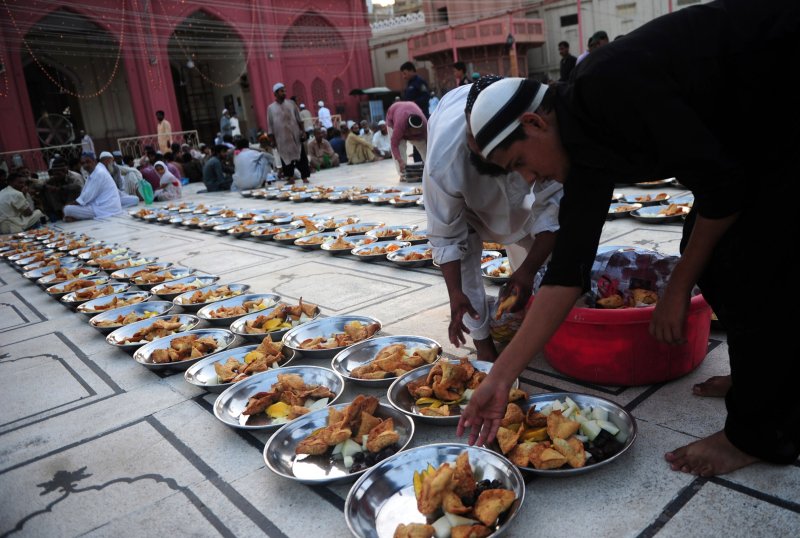
Ramadan, Day 4: Eating Haves and Have Nots


A Pakistani Muslim man arranges Iftar food for Muslim devotees before they break their fast during the holy fasting month of Ramadan in Karachi on June 30, 2014.
 
ASIF HASSAN—AFP/Getty Images
BY SOHAIB N. SULTAN 

The holy month of Ramadan is a time of deep reflection for Muslims worldwide. Over the 30 days of Ramadan, Imam Sohaib Sultan of Princeton University will offer contemplative pieces on contemporary issues drawing from the wisdoms of the Qur’an – the sacred scripture that Muslims revere as the words of God and God’s final revelation to humanity. The Qur’an is at the heart of Muslim faith, ethics, and civilization. These short pieces are meant to inspire thought and conversation.

Recently, a friend offered a social commentary that really stuck with me. He said, “You know there’s something wrong when too many people in the world are dying because of starvation and, at the same time, too many people are dying because of overeating.”

It reminded me of a simple yet quite profound advice in the Qur’an: “O Children of Adam…eat and drink, but not excessively: verily, God does not like the excessive” (7:31). Reflecting on this teaching, the Prophet Muhammad advised: “No human being overfills a vessel worse than the stomach. Sufficient for any child of Adam are some morsels of food to keep their back straight. But, if they must [eat more than this], then let one third be for food, one third for drink and one third for easy breathing.”

Moderation is an oft-repeated virtue in the Qur’anic discourse on living an ethical life. When it comes to our eating habits, it goes beyond our individual ethics to a more communal ethics. When extreme food waste and extreme lack of food coexist as a reality not only in the world but even, often, in the same cities, then we’ve really got to re-think how we eat and how much we eat. For example, the USDA estimates in a 2014 report that around 40% of food in America goes to waste. And, it is also estimated that 50 million Americans (1 in 6, and more than 1 in 5 children) go to sleep hungry everyday.

Of course, the problems as well as the solutions are much more systemic. But the shift in how much we eat and how we treat food needs a cultural revolution. It requires an honest conversation about the epidemic of obesity, on the one hand, and a critique of the “ideal” body type – which is just as much part of the problem – on the other hand. And, it begins with all of us, individually and in our homes, considering how we can reduce food waste and reduce the imbalance between those who have and those who do not have.

Fasting really makes you re-think the role of food in your life. It is a proof for how little we actually need to stay strong and healthy and how our appetites are so much more adjustable than we think. Breaking fast together in community also makes you think. When food is shared, it seems so much more plentiful as a little bit goes a long way when you eat in good company. As the Prophet Muhammad would say, “food for one is enough for food for two, and food for two is enough for food for three” and so on.

Just some food for thought during this month of Ramadan. - time.com

Wednesday, 14 April 2021

Ramadan, Day 3: 5 Principles for Understanding “Difficult” Qur’anic Passages


A Indian Muslim reads the Koran at a madrassa during the Islamic holy fasting month of Ramadan in Mumbai on June 30, 2014.
 
Indranil Mukherjee—AFP/Getty Images

The holy month of Ramadan is a time of deep reflection for Muslims worldwide. Over the 30 days of Ramadan, Imam Sohaib Sultan of Princeton University will offer contemplative pieces on contemporary issues drawing from the wisdoms of the Qur’an – the sacred scripture that Muslims revere as the words of God and God’s final revelation to humanity. The Qur’an is at the heart of Muslim faith, ethics, and civilization. These short pieces are meant to inspire thought and conversation.

When I have the opportunity to engage with people of other faiths, I am often asked about controversial passages in the Qur’an that seem belligerent toward non-Muslims. It would require an entire book to go over every single such passage and offer theories of interpretation and explanation. So, I would like to offer something else as food for thought: five principles to keep in mind when studying or trying to understand these difficult Qur’anic passages.

  1. Islam is the third and last of Abraham’s sibling faiths following Judaism and Christianity. Each religion offers a vigorous critique of what came before, partly as a justification for needing a new prophet and revelation. As such, Islam has much to say in way of praise as well as criticism of Jews and Christians as previously revealed faiths. If Islam had come before Judaism or Christianity, they would surely have had similar critiques of Islam.
  2. The Qur’an, when offering critiques of Jews and Christians, always uses the term in Arabic “al” to indicate “the,” which in the Arabic language indicates specificity, not generality. In other words, all of these verses are talking about a specific group of Jews and/or Christians, by no means all Jews and Christians. In fact, the Qur’an itself reminds Muslims: “But they are not all alike. There are some among the People of the Book who are upright, who recite God’s revelation during the night, who bow down in worship, who believe in God and the Last Day, who order what is right and forbid what is wrong, who are quick to do good deeds. These people are among the righteous and they will not be denied [the reward] for whatever good deeds they do: God knows exactly who is conscious of Him” (3:113-115). All passages that offer criticism of Jews or Christians must be tempered with this cautionary passage.
  3. From a Muslim perspective, the Qur’an is not playing favoritism toward any one subjective group but rather more interested in objectively holding up truth and righteousness. As such, it does offer scathing criticism of Jews and Christians when their communities failed to uphold truth and righteousness, but there are also passages in the Qur’an where God offers scathing criticism of Muslims for their failings too. In fact, if you collect all of the passages in the Qur’an that are specifically addressed to the Muslims (usually beginning with “O you who believe”), what often follows is a criticism or a warning. For example, “O you who believe, why do you say things and then do not do them? It is most hateful to God that you say that which you do not do” (61:2-3).
  4. These passages from the Qur’an must be read keeping in mind two contexts: historical and textual. When you come across a passage in which the Qur’an is condemning Jews or Christians, you have to pause and ask yourself what was happening at the historical time of the revelation and what is it that the Qur’an is actually responding to. And, you have to also ask yourself if there are other passages within the Qur’an that temper or clarify the “difficult” passage. For example, in Chapter 5, the Qur’an strongly discourages Muslims from taking Jews and Christians as their allies (awliyah). But, much later in the Qur’an, in Chapter 60, it clarifies that the previous passage was meant only for those who acted belligerently toward the Muslims, not those who were good to the Muslims and kept their treaties with them.
  5. Lastly, one has to keep in mind when reading such passages that the Islamic tradition has a long and vast history of developing schools of interpretation around the Qur’an that dissect every verse of the Qur’an with linguistic and grammatical analysis, historical context and commentary, to name only a few. As such, as is true with other revealed scriptures, a literal and outward reading of the text – let alone the translated text – defies the way in which Muslims have read and understood their scripture for centuries. - time.com

Ramadan, Day 2: Approaching the Qur'an


A Muslim man reads the Koran during Ramadan.
 
Dan Kitwood—Getty Images

The holy month of Ramadan is a time of deep reflection for Muslims worldwide. Over the 30 days of Ramadan, Imam Sohaib Sultan of Princeton University will offer contemplative pieces on contemporary issues drawing from the wisdoms of the Qur’an – the sacred scripture that Muslims revere as the words of God and God’s final revelation to humanity. The Qur’an is at the heart of Muslim faith, ethics, and civilization. These short pieces are meant to inspire thought and conversation.

Day 2

Approaching the Qur’an

As a Muslim chaplain and author of two books on the Qur’an – The Koran for Dummies (Wiley, 2004) and The Qur’an and Sayings of the Prophet Muhammad: Selections Annotated & Explained (Skylight Paths, 2007) – I am often asked by Muslims and people of other faiths how to access and read the Qur’an. The question is more complicated than it may first seem.

The Qur’an has a few distinctive features that can prove challenging for people who are only used to reading Western literary works. To begin with, the Qur’an is originally in Arabic, so when the Qur’an is read in English or any other language it is, obviously, a translation. Muslims would widely claim that a translation is, in fact, by its very nature an interpretation because words and the shades of meaning they contain can be translated in so many different ways depending upon the translator’s own school of interpretation.

Furthermore, words in the translated language are understood through a cultural history that may or may not be tuned to the Qur’anic message. For example, when the Qur’an chides the kaafir this can be translated as “infidel,” “one who rejects faith,” or simply “disbeliever” – just to mention some of the common translations of the word. Each translation implies something significantly different based on how we as English speakers understand these words with our own particular historical baggage.

It may help, therefore, to compare and contrast at least two or three translations, especially when you come across a tricky word, to get a sense of the shades of possible meaning. You can even compare translations quite easily nowadays using online resources. Secondly, the Qur’an is non-chronological – meaning that it does not begin with the first revelation and end with the last revelation as the Prophet Muhammad and his community would have experienced it over the span of 23 years in 7th century Arabia. Rather, the Qur’an is ordered in the order in which the Prophet Muhammad and successive generation of Muslims recited it from beginning to end. As such, earlier revelations that the Prophet received in Mecca are usually found near the end, and later revelations which the Prophet received in Medina are usually found near the beginning.

The difference between the Meccan and the Medinan phases of revelation reflect what the Prophet and his early community were going through. In Mecca, the Qur’an preaches a message of God’s absolute Oneness, finding nobility through righteous conduct and deeds, enduring patiently through difficult times, and being certain that there will be accountability and an afterlife – reflecting the humble origins and struggles of the early movement as well as the foundational teachings of the new religion. The Medinan phase reinforces these teaching, but moves toward a more social message with communal laws and concerns addressed such as marriage, business transactions, war and interfaith relations – reflecting the Prophet and his community’s shifting fortunes as an emerging faith civilization. To understand this phenomenon and how it affects our approach to the Qur’an, I would recommend reading Dr. Ingrid Mattson’s The Story of the Qur’an (Blackwell Publishing, 2008).

Lastly, the chapters of the Qur’an – especially the earlier chapters – are largely made up of a non-linear narrative form with usually no clear beginning, middle, or end. These Qur’anic chapters read more like a stream of consciousness or a series of sermons. Stories are told, but rarely ever fully – just enough to get a theological, spiritual, or ethical message across. The key is in understanding that the Qur’an is putting forth a moral narrative in which stories, glad tidings, warnings, prescriptions, and proscriptions are all used to support a core teaching.

In other words, the shifting from one story to another or one law to another in the Qur’anic narrative is about connecting all the different ways in which human beings comprehend a message and directing them toward a belief, inner attitude, or ethical action. This is why, for example, the story of Prophet Moses is told in so many different places in the Qur’an, in bits and pieces, because it’s never really about Moses – it’s about something greater that the story of Moses illustrates. The translation that probably best reflects this coherence and flow in narrative is the marvelous translation by Abdul Haleem (Oxford University Press, 2010).

Interestingly, when the Qur’an is recited in its original Arabic there is nothing that sounds more harmonious to the ears. This is the way that Muslims experience the Qur’an – through the oral tradition. The aura of the Qur’an is found, arguably, in its recited form. It is no coincidence that the Qur’an literally means “that which is recited.” The art of Qur’anic recitation is one that is learned and mastered over years. But, even a person who does not know a word of Arabic can recognize the awesomeness of the recitation. As such, my final piece of advice would be to listen to some Qur’an – it will give you insights that cannot quite be comprehended by the mind alone. Reading the Qur’an is just as much a spiritual exercise as it is an intellectual one. - time.com

Monday, 12 April 2021

Ramadan, Day 1: What Is Ramadan?


A Muslim boy reads the Koran during the month of Ramadan, Kuala Lumpur, July 30, 2013.
 
Mohd Rasfan—AFP/Getty Images

The holy month of Ramadan is a time of deep reflection for Muslims worldwide. Over the next 30 days, Imam Sohaib Sultan of Princeton University will offer contemplative pieces on contemporary issues drawing from the wisdoms of the Qur’an – the sacred scripture that Muslims revere as the words of God and God’s final revelation to humanity. The Qur’an is at the heart of Muslim faith, ethics, and civilization. These short pieces are meant to inspire thought and conversation. So, let the dialogue begin…

Day 1

What is Ramadan?

Ramadan is the ninth month of the Islamic lunar calendar. More significantly, it is the month in which Muslims believe the Qur’an descended from God to the lowest heavens in preparation for revelation, in stages, to Muhammad, the final prophet of Islam. So, the month is a celebration of the Qur’an which is experienced by believers as a source of guidance and criterion for human life.

To celebrate this source of eternal guidance, Muslims are prescribed to partake in a fast primarily from eating and drinking from sunrise to sunset every day of the month. The spiritual discipline is meant to train the human soul in deeper mindfulness and self-restraint. Fasting proves to us that we are, indeed, masters over our own passions and that we can reach for greater heights beyond our lower desires. The Prophet Muhammad taught his followers that God has no need for a person to fast from food and drink if they don’t fast from false speech and other greater sins. The spiritual sages of the Islamic tradition say that there is, in fact, a type of fasting that is required for every limb of the body from that which is unethical and immoral. These are teachings that are at the heart of Qur’anic spirituality.

The discipline is also meant to teach us the invaluable lesson of gratitude to God for the immeasurable blessings and favors with which we have been bestowed. Through deprivation there is a greater appreciation for what we have. And part of this is inculcating a very personal empathy for those who don’t have, as we experience similar pangs of hunger and thirst that are felt unwillingly by people all over the world, every day. As such, Ramadan is a month that encourages charity, kindness and social justice on behalf of the poor and needy in particular. In this way, fasting connects us to the social message of the Qur’an.

The Qur’an reminds believers that “fasting is prescribed for you as it was prescribed for those before you” (2:183). Some form of fasting is found in every spiritual tradition. And, therefore, fasting and the great lessons we learn from it are meant to bind us together as human beings. Ramadan is a perfect time to build bridges and reconciliation with friends, neighbors, classmates, and co-workers – regardless of religion.

Let’s break bread together often this month. Ramadan Mubarak! - time.com