Islam

Islam

Monday, 26 April 2021

Ramadan, Day 14: A Wedding Sermon


BY SOHAIB N. SULTAN

The holy month of Ramadan is a time of deep reflection for Muslims worldwide. Over the 30 days of Ramadan, Imam Sohaib Sultan of Princeton University will offer contemplative pieces on contemporary issues drawing from the wisdoms of the Qur’an – the sacred scripture that Muslims revere as the words of God and God’s final revelation to humanity. The Qur’an is at the heart of Muslim faith, ethics, and civilization. These short pieces are meant to inspire thought and conversation.

To all the newly wed or soon to be couples out there, I offer you my wedding sermon…

Marriage is not just a legal contract; it’s a spiritual one too. This spiritual covenant is, perhaps, most beautifully described in the Qur’an when God says that a wife is like a garment for her husband, and a husband is like a garment for his wife (2:187). If we think what a garment does – it beautifies, elevates, comforts, covers and completes a person. Likewise, you are called to be this for each other through this spiritual covenant.

Marriage has a very real and high purpose. The Qur’an puts it this way: “so that you may dwell in tranquility” (30:21). It is tranquility that gives you a taste of the spiritual home that you came from and the home to which your soul yearns to return to – the abode of the hereafter that is filled with gardens for the righteous. So help each other cultivate this garden of tranquility here on Earth in preparation for that garden of tranquility that awaits.

To grow this garden, God gives you as a wedding gift two seeds with which to plant your flowers and trees: “And God places between [your hearts] love and compassion” (30:21). Love is to always want for your spouse what you want for yourself – Prophet Muhammad’s golden rule. It is to think of your spouse and to consider him or her well when you are together and when you are not. Love means commitment and loyalty. Compassion is to strive to be and remain empathetic toward each other throughout life, and to never allow apathy to settle between yourselves. It means listening to each other and being there for each other during times of ease and difficulty. And it means being able to forgive each other for shortcomings often and readily.

Every garden needs three things to grow beautifully and healthily: fertile soil that you can plant your roots in, sunlight everyday and nourishing rain that visits often enough.

Let the fertile soil of your marriage be God consciousness. If your marriage is rooted in the powerful idea that God has brought you together and that you’re, in the end, responsible before God in how you treat each other, then your marriage will be rooted in something that can withstand even the heaviest of storms. So pray together often. Fast together when you can. And go out and give in charity and serve the needs of others always. You will find God with you.

Let the sunlight everyday be gratitude – gratitude to God, yes, but also gratitude to each other. Recognize the blessing that each of you is for the other. Let no day go by in which you do not exchange gifts of gratitude. The simplest gifts, like a warm smile on a rainy day, can be the most valuable of these gifts. Giving each other your time, no matter how busy life gets, is the most important of these gifts. And, don’t let a day go by in which you do not say “Thank you” or “God bless you,” simple but important words of appreciation.

And, let the nourishing rain be patience and perseverance. This is simply because life is not always easy and being in a relationship is not always fruits and peaches. It takes struggle, sacrifice and hard work. Take each other by the hand and commit to going forward through every peak and valley with fortitude. And as God says, do this not grudgingly but with “beautiful patience” (70:5).

In conclusion, every couple has a critical decision to make: whether this garden of tranquility will be just for yourselves and your own enjoyment, or whether this garden will be for all those around you – your families, relatives, friends, community and society. I would submit to you that a holy marriage is one that chooses the latter. And this is why we pray, “May God unite you in all that is good,” because God has brought you together to be a force for spreading goodness in the world beginning with those who are closest to you. Therefore, let your marriage be about something much greater than your own selves.

We pray, then, that when people walk through your garden of tranquility and eat the fruits thereof, they say this is surely “from among the signs of God…for those who ponder” (30:21). And we pray as God asks the righteous to pray, “O our Guardian-Sustainer! Grant that our spouses and our children are a coolness for our eyes, and make us foremost among those who are God-conscientious and righteous” (25:74).

Sunday, 25 April 2021

Ramadan, Day 13: Modesty


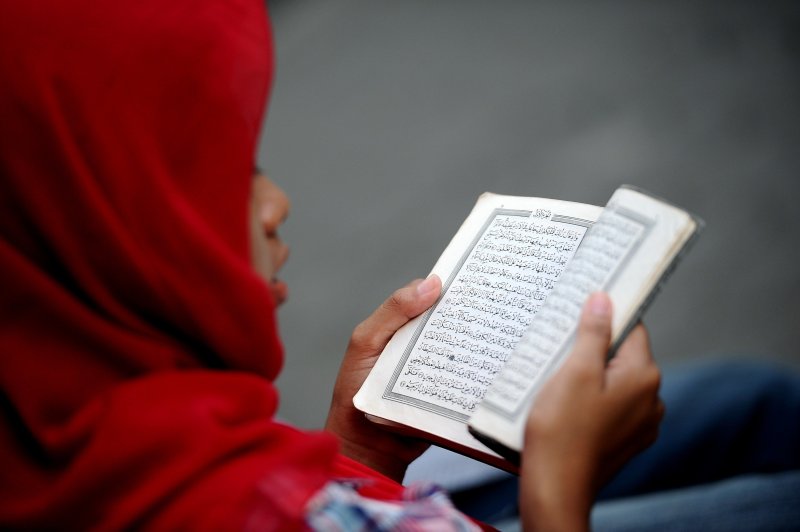
An Indonesian Muslim girl reads the Quran as she waits for the breaking of the fast during Ramadan on July 6, 2014 in Surabaya, Indonesia.
 
Robertus Pudyanto—Getty Images
BY SOHAIB N. SULTAN

The holy month of Ramadan is a time of deep reflection for Muslims worldwide. Over the 30 days of Ramadan, Imam Sohaib Sultan of Princeton University will offer contemplative pieces on contemporary issues drawing from the wisdoms of the Qur’an – the sacred scripture that Muslims revere as the words of God and God’s final revelation to humanity. The Qur’an is at the heart of Muslim faith, ethics, and civilization. These short pieces are meant to inspire thought and conversation.

I’m often asked why many Muslim women cover their hair and dress apart. I used to reply by proclaiming the virtue of modesty. I would often receive a blank stare or a look of confusion. Slowly, I came to realize that modesty is, in fact, not only a lost virtue in our times but also a word that is understood differently by different people.

If we look at the Merriam-Webster dictionary, the first definition of modesty that comes up is “the quality of not being too proud or confident about yourself or your abilities.” All of the synonyms that go with modesty, such as “meekness” and “lowliness,” reinforce this definition. This understanding of modesty is why the American sage Maya Angelou (may God rest her soul) is quoted as saying: “I’m a religious woman. And I feel I have responsibility. I have no modesty at all. I’m even afraid of it – it’s a learned affectation and it’s just stuck on me like decals. Now I pray for humility because that comes from inside out.”

But, largely, when Muslims refer to modesty, this isn’t what they’re referring to. It is the second, and lesser known, definition that is at the heart of modesty’s virtue: “propriety in dress, speech, or conduct.” Propriety and goodly comportment are really what modesty as a virtue is all about. This virtue is universally proclaimed, to varying degrees, across faith traditions.

In Islam it takes on great importance because the Prophet Muhammad said, “every religion has a chief characteristic and the chief characteristic of Islam is modesty.” Even though we, as Muslims, have become obsessed with women’s modesty, modesty is a virtue for both men and women. In fact, the Prophet himself was described as being the epitome of modesty in his behavior with people. And, when the Qur’an tells believers to lower their lustful gazes and guard their chastity – important aspects of the modesty tradition – it begins by commanding this to men before women (24:30 – 31).

The Arabic word for modesty is hayaa. The interesting thing about this word is that it is linguistically related to the Arabic word for life (hayat). Muslim scholars and sages have taken from this that there is an intimate connection between the two terms. Modesty, it is said, is the virtue that gives spiritual life to the soul.

This connection between spiritual life and modesty exists because the virtue is not just about outward appearances; rather, it is first and foremost about the inward state of having modesty before God – meaning an awareness of divine presence everywhere and at all times that leads to propriety within oneself and in one’s most private moments.

Outward modesty means behaving in a way that maintains one’s own self-respect and the respect of others, whether in dress, speech or behavior. Inward modesty means shying away from any character or quality that is offensive to God. The outward is a reminder of the inward, and the inward is essential to the outward. - time.com

Friday, 23 April 2021

Ramadan, Day 12: Sex Slavery and Objectification of Women


BY SOHAIB N. SULTAN 

The holy month of Ramadan is a time of deep reflection for Muslims worldwide. Over the 30 days of Ramadan, Imam Sohaib Sultan of Princeton University will offer contemplative pieces on contemporary issues drawing from the wisdoms of the Qur’an – the sacred scripture that Muslims revere as the words of God and God’s final revelation to humanity. The Qur’an is at the heart of Muslim faith, ethics, and civilization. These short pieces are meant to inspire thought and conversation.

Recently, on my drive home I was listening to Public Radio when I came across a story that just boiled my blood and sunk my heart. It was the story of mostly young and vulnerable women who were kidnapped from Tenancingo, Mexico and forced into sex slavery right here in the United States. It is the single largest source of sex slaves in America according to this report.

The latest studies estimate that there are more than 20.9 million people – mostly girls and women – who are forced into sex slavery worldwide. And, sex trafficking is the fastest growing criminal enterprise in the world today. These statistics can just sound like numbers until we pause and think of the individuals who suffer through this evil. We may not know them by face or name, but they do have faces and they do have names and they really do matter.

The problem of sex trafficking can seem beyond our control, but there are some wonderful organizations out there fighting the good fight everyday that we can support in whatever ways we can to help end this evil. And, as citizens we can demand that our government do more domestically and internationally to further the cause of human freedom. As a nation, abolishment of slavery was and is an important milestone in our history. We now have to go the extra mile to end slavery in all of its illegal forms starting here at home.

I would like to argue that there is something else we can do too – something that requires moral courage, introspection, and ultimately a cultural shift. We can start a movement against the sexual objectification of women. If we are really honest, the shocking evil of sex trafficking is in, some ways, only an extension and the ugliest manifestation of treating women like commodities. From selling cars and clothes to beer and chips and everything in between, we have become quite comfortable with the sexual objectification of women in society. And, somehow as long as a woman consents and is over the random age of 18 or 21, it becomes completely legal to sexually and commercially exploit her.

Sadly, many women – young girls in particular – have internalized a lot of this objectification around them on highway billboards, television and movie screens, and Internet. For it nowadays to be common and culturally acceptable for a young girl to walk around in the mall, for example, with something like “juicy” written across her backside or across her chest is an indication of the serious problem that lies before us.

Needless to say, women are not objects – they are human beings who have souls and intellects and are endowed with God-given dignity that no man or corporation should ever be able to take away from them. Starting with the way we raise our boys and our girls, we are desperately in need of a cultural shift – locally and globally – on how we think of women.

A young man once came to the Prophet Muhammad asking permission to commit fornication with women. The Prophet drew the young man closer to himself, put his hand on his shoulders, and asked, “Would you like this for your sister or your mother or your daughter?” The man immediately replied that he would hate it. The Prophet said, “then, how can I permit you to do this with someone else’s sister, mother, or daughter?”

Ramadan is the month in which we learn to discipline our sexual appetites through the spiritual discipline of fasting. The idea is not sacrifice our appetites completely at the altar of monasticism, but rather to bring our inclinations into conformity with a higher and more ethical way. If people were not slaves to their sexual appetites there would be no industry for sex slavery. And, if people learned to control their sexual glances, there would be far less objectification of women. As with everything else that is good, it all begins with the self. - time.com

Thursday, 22 April 2021

Ramadan, Day 11: Faith and Reason


BY SOHAIB N. SULTAN

The holy month of Ramadan is a time of deep reflection for Muslims worldwide. Over the 30 days of Ramadan, Imam Sohaib Sultan of Princeton University will offer contemplative pieces on contemporary issues drawing from the wisdoms of the Qur’an – the sacred scripture that Muslims revere as the words of God and God’s final revelation to humanity. The Qur’an is at the heart of Muslim faith, ethics, and civilization. These short pieces are meant to inspire thought and conversation.

As a chaplain, I meet quite a few people who have left Islam or are on the brink of leaving the faith. The reasons for leaving Islam, I found, are varied. But, one answer that kept coming up goes something like this: “I had a lot of questions and I was told not to question my faith, so I just decided it wasn’t for me.” It’s usually more complex than that, but that’s pretty much the gist.

To me, this means that too many Muslims who experience a crisis of faith are being turned away by their family members or even religious leaders who, basically, tell them that Islam is a religion of surrendering oneself to God – take it or leave it. If Islam is to survive and thrive in America and beyond, this is one attitude that will have to change wherever it may exist.

Even though, yes, Islam is based on this understanding of bringing one’s inward and outward in harmony with God’s teachings and guidance – there is much room for doubt, questions, and reason. This is simply so because knowing the reality of God and what God wants from us is not always easy to know. Blind faith is not asked of us nor is it even encouraged.

In fact, the Qur’an is full of criticism for those who simply believe or do things based on what they learned from their ancestors without independently thinking or contemplating its truth (2:170 and 5:104). Furthermore, one of the most oft-repeated lines of the Qur’an says that this message is for those who deeply think and ponder (2:163). Similarly, the Qur’an in multiple places commends those who contemplate and use their intelligence (3:190).

The Qur’an also tells of the angels who dared to question God’s decision to put human beings on earth upon realizing that they would, by virtue of their capacity to disobey God, spread mischief and bloodshed (2:130). There is also the story of Prophet Abraham – who is praised as a sincere devotee of God and given the title of “intimate friend of God” – who, nonetheless, asks God how it is that he will resurrect and bring back to life that which is dead (2:260). And, we have the story of Prophet Moses who is honored for speaking directly to God, yet asks God to show himself (7:143).

When it comes to convincing people of faith, the Qur’an is filled with passages that employ signs within the human being and in the universe to contemplate the existence, oneness, and genius of God (2:163 – 164). The Qur’an also shows in Prophet Abraham, as a model of faith, someone who is at every step using his reason to preach to his people, pointing to the signs in the heavens (2:258 and 6:74 – 79) and showing the weakness of the manmade idols (21:51 – 67).

Likewise, the prescriptions and proscriptions that are found in the Qur’an are usually given a clear rationale and not just expected to be followed without consideration. The Prophet Muhammad, too, would invite his companions to ask questions – sometimes very difficult and personal questions – and would answer them calmly and intelligently. The prophetic biography is full of such instances.

All of this is to argue that in Islam doubt, questions, and human reasoning are not at all antithetical to faith. In fact, it can very well be argued that faith is not complete without these things. All of this, of course, presupposes that we are sincere in our inquiry and that we want the truth to manifest rather than simply our egos to be satisfied. This is why the lifelong journey of faith and reason is as much a spiritual effort as it is an intellectual one.

On this point, the Qur’an will readily admit that faith cannot be achieved through the intellect alone. Faith, by its very nature, is a belief that settles and finds conviction in the heart with the aid of the mind. Spiritual disciplines like prayer and fasting are the methodologies by which faith becomes rooted in the heart. In the realm of metaphysics these spiritual methodologies are essential. Just as a scientist cannot run around the lab chanting God’s names and expecting his or her experiment to succeed, a spiritual seeker cannot simply apply the scientific methodology to metaphysical questions and expect an answer. - time.com

Ramadan, Day 10: Reconciliation


BY SOHAIB N. SULTAN

The holy month of Ramadan is a time of deep reflection for Muslims worldwide. Over the 30 days of Ramadan, Imam Sohaib Sultan of Princeton University will offer contemplative pieces on contemporary issues drawing from the wisdoms of the Qur’an – the sacred scripture that Muslims revere as the words of God and God’s final revelation to humanity. The Qur’an is at the heart of Muslim faith, ethics, and civilization. These short pieces are meant to inspire thought and conversation.

In yesterday’s piece, I offered some reflections on the tradition of forgiveness in Islam. But, forgiveness is, preferably, just a step – if not the first step – toward an even greater objective: reconciliation.

If forgiveness requires an epic struggle with the ego, then reconciliation – actually opening yourself up to a harmonious relationship with a past foe – requires something quite heroic. And, beyond the individual there is also the matter of reconciliation between entire communities. Today’s world is in much need of healing and reconciling between religions, ethnicities, races, and other factions.

As a Muslim, one of the most troubling divisions I am witnessing right now is between Sunnis and Shia’ in certain parts of the Muslim World. There has been terrible violence and bloodshed in places like Pakistan and Iraq. And, the sectarianism on the streets and around the dinner tables is quite ugly too. We need a few good men and women to work toward peace and reconciliation during these dark times.

One of the most positive moves in recent memory was when hundreds of senior Muslim scholars representing different schools of thought in Islam came together to sign the historic Amman Message in Jordan, which called on Muslims to co-exist peacefully and respectfully wherever they may live. But, the implementation of the historic document is still lagging far behind.

The Qur’an itself emphatically states, “The believers are brothers [and sisters], so make peace between your brothers and be mindful of God so that you may receive mercy” (49:10). There are several other passages that encourage peacemaking between people, in general, as well (4:114 for example). The Prophet Muhammad said, “Shall I tell you of something that is better than fasting, prayer, and charity? [It is] reconciling between two people.”

Here are three principles from the Qur’an that offer insights on how to actually make reconciliation happen:

1) “God may still bring about affection between you and your [present foes] – God is all powerful, God is most forgiving and merciful” (60:7). In other words, no matter how bad things get, never close the door on the possibility of reconciliation.

2) “…Repel wrong with goodness and your foe will become as close [to you] as an old and valued friend, but only those who are steadfast in patience, only those who are blessed with great righteousness, will attain to such goodness…” (Qur’an 41: 34 – 35). The offering of kind words, gifts, and so on in the midst of enmity can soften the hearts toward a more peaceful future.

3) “O you who believe, uphold justice and bear witness to God, even if it is against yourselves, your parents, or your close relatives…refrain from following your own desire, so that you act justly – if you distort or neglect justice, God is fully aware of what you do” (4:135). Usually when there is a falling out and enmity between two people or between communities, there is a need to rectify a past wrong. By the end of a conflict there are probably wrongs on both sides that need to be rectified. While calling for absolute justice ends up in cycles of unending conflict, some measure of justice and fairness is needed for people to be able to move on.

I pray, despite all odds, that Ramadan is the month in which hearts are brought closer together, relationships are repaired, and loving friendships are formed. I pray, for prayer is our best hope for beating the odds. As Muslim country musician, Kareem Salama puts it in his song Prayers at Night: “But we can bend iron with our prayers at night. Yes, we can bend iron with our prayers at night.” - time.com

Tuesday, 20 April 2021

Ramadan, Day 9: Forgiveness


BY SOHAIB N. SULTAN

The holy month of Ramadan is a time of deep reflection for Muslims worldwide. Over the 30 days of Ramadan, Imam Sohaib Sultan of Princeton University will offer contemplative pieces on contemporary issues drawing from the wisdoms of the Qur’an – the sacred scripture that Muslims revere as the words of God and God’s final revelation to humanity. The Qur’an is at the heart of Muslim faith, ethics, and civilization. These short pieces are meant to inspire thought and conversation.

Forgiveness is at the heart of so many spiritual and ethical traditions. But, it can be one of the most difficult teachings to live up to. Forgiveness requires an extraordinary struggle against the bruised ego. And, the bigger the hurt, the more difficult it is to forgive. Ultimately, though, there is nothing like forgiveness that can set a person free and to put a mind at rest.

In the Islamic tradition teachings on forgiveness are intimately connected to and rooted in a deeper theological understanding of God and of the relationship between God and the human being.

The foremost attributes of God – which open up every chapter of the Qur’an – are the merciful (al-rahman) and the compassionate (al-raheem). And, one of the most celebrated names of God in the Qur’an is the forgiving (al-ghafur). There are several other divine attributes that are similar.The way in which this relates to the human being is two-fold:

First, at the heart of Islamic spirituality is this idea that we have a share, no matter how small in comparison to God, of divine attributes by virtue of the life-giving and divinely originating soul (ruh) that is breathed into us by the angels when we are still fetuses in our mother’s wombs. It is, then, our spiritual task to cultivate and grow these beautiful attributes within our soul and character in order to draw closer to the divine. Forgiveness is an opportunity to adorn our souls with godliness. And, the more difficult it is to forgive, the greater and more beautiful the adornment. As such, one of the motivations to forgive is to draw closer to God’s attributes. Forgiveness should be seen as an opportunity – a chance at experiencing and achieving a nearness to God that is indescribable in its beauty and tranquility. This is why the Qur’an describes those who are deeply aware of God as “when they are angered they forgive” (42:37) and “when they are prompted by the ignorant they respond with words of peace” (25:63).

Second, there’s a deep sense that the way we treat others is the way that we will be treated by God. In other words, if we wish for God’s gentle treatment toward us then we must be gentle toward others. This teaching is reflected in what is referred to as the foundational prophetic teaching – meaning that the first saying attributed from the Prophet Muhammad (hadith) that a teacher of hadith imparts to his or her student – which states: “Show mercy toward those on earth and the One above the heavens will show mercy toward you.” And, this is, furthermore, a reflection of the Qur’anic advice: “…pardon and forgive. Do you not wish that God should forgive you?” (24:22).

In this month of Ramadan we’re especially encouraged to seek God’s forgiveness for our wrongdoings and shortcomings. What better way to seek this divine forgiveness then by forgiving those who have wronged and hurt us?

Once when the Prophet Muhammad was sitting in the Mosque with a group of his companions, he caught everyone by surprise by stating that the next person to enter the sanctuary would be a person of paradise. The Prophet’s companions waited eagerly to see who it would be. Finally, a rather simple man by the name of Abu Dumdum appeared. The companions were befuddled because they didn’t think that this person was extraordinarily pious. One of the companions asked Abu Dumdum if he could stay with him for a few nights making an excuse of need. In reality he just wanted to know what was so special about Abu Dumdum. In the night the companion expected Abu Dumdum to pray all night – but no such thing happened. During the day, the companion expected Abu Dumdum to fast, but that didn’t happen either. Finally, the companion told Abu Dumdum about what the Prophet had said and why he was actually spending nights in his home. Abu Dumdum replied that the only thing he did that was different and unique was before going to bed every night he would forgive anyone who had offended him knowingly or unknowingly, and would go to sleep with a clean heart toward others.

Forgiveness is not easy, but boy is it worth it! - time.com

Monday, 19 April 2021

Ramadan, Day 8: Finding Inner Freedom


BY SOHAIB N. SULTAN

The holy month of Ramadan is a time of deep reflection for Muslims worldwide. Over the 30 days of Ramadan, Imam Sohaib Sultan of Princeton University will offer contemplative pieces on contemporary issues drawing from the wisdoms of the Qur’an – the sacred scripture that Muslims revere as the words of God and God’s final revelation to humanity. The Qur’an is at the heart of Muslim faith, ethics, and civilization. These short pieces are meant to inspire thought and conversation.

During this July 4th weekend I have been thinking much about the concept of freedom as we celebrate Independence Day in the United States. I know that I am eternally grateful for the freedom of religion and conscience, and of speech, work, movement and so much more. And, I recognize that this freedom is a blessing that many are deprived of in the world.

When I was much younger I lived for a few years in Saudi Arabia. There, even though life was comfortable, the absence of freedom, in many ways, was strongly felt. It seemed to completely stifle any sense of civic life and society.

Nowadays, there is a lot of clamor in parts of the Muslim World for greater freedom. The Arab Spring and Tahrir Square in Egypt, for example, became symbols of this yearning to live freely. People took to the streets to topple their governments, believing that they could finally experience freedom if they were freed from the yoke of oppressive dictatorships. This desire to be free is not just an awareness of the freedoms enjoyed in parts of the West as many have suggested, but it is a much more innate and natural desire that stirs deep within the human soul. It may have something to do with the very way we come into the world…

The early Muslim sage and second caliph of Islam, Umar bin al-Khattab, reportedly warned one of his governors – in a quickly expanding Muslim empire – against taking slaves, saying, “O ‘Amr! When did you begin to enslave and subjugate people after their mothers have given birth to them as free people?”

Freedom in the modern world is almost exclusively spoken of in terms of outward rights. But, there is another aspect of freedom that deserves just as much, if not more, attention: inner freedom. In reality, without a philosophical discourse and sincere realization of inner freedom, people may experience all the outward freedom in the world and still feel totally imprisoned.

The Prophet Muhammad is an exemplar of what inward freedom looks like. When he was oppressed and mocked for his teachings during the first 13 years of his prophetic mission, he never replied rudeness with rudeness or harshness with harshness. When the Prophet became the leader of a people for the next 10 years and was forced to fight in battles to protect his community, even then he never allowed hatred to get the best of him and continued to pray for his enemies. When the Prophet was given a chance to engage in perpetual war with his rivals or sign a peace-treaty filled with concessions, he had the insight to choose peace. And, when the Prophet returned victorious to Mecca toward the end of his life, he chose amnesty and forgiveness over revenge. All of this the Prophet did because he was remarkably and truly free.

Nelson Mandela, may God rest his soul, said, upon leaving the prison where he had been held for 27 years, “As I walked out the door toward the gate that would lead to my freedom, I knew if I didn’t leave my bitterness and hatred behind, I’d still be in prison.”

These are sagacious words for our times. In the midst of riots and revolutions for the sake of freedom, this inner freedom we cannot afford to forget. For once the outward dictator is overthrown we achieve nothing if the inner dictator is well and alive. Without inner freedom the cycles of oppression continue on and on.

Each one of us has a life long struggle to unshackle ourselves from the inner desires, passions, and ego that seek to be masters over us. Fasting during this month of Ramadan has been an intense and serious lesson in what it means to gain master over lower inner qualities and to attain to a higher state – a state that finds its freedom in God and godliness. - time.com